AI Accountant for Businesses: In-house Vs AI Junior
How is an in-house accounting team different from an AI Junior Accountant? Find out how Lighthaus can help Indian companies automate their data entry, reconciliation, and other accounting processes.


In this Article
In-House Accounting Team vs. In-House Team Plus AI Junior Accountant: Which Scales Better?
Your firm has grown. The number of transactions has doubled. New vendors have joined the business. Marketplaces settlements need reconciliation. And GST compliance has become tricky.
Your accounting team works harder than ever. However, the books close later than ever before.
What now? Should you hire yet another junior accountant? Or expand your finance department further? Or outsource part of the job? Or should you figure out how to help the existing team scale?
For many firms in India, the above options might not hold the key.
An alternative option could be an AI Accountant for Businesses, which helps your accounting team offload the routine work, while letting humans do their thing.
Here lies the notion of the junior accountant of the AI sort.
At Lighthaus, we take a different approach than traditional accounting automation software. The AI agents process high-volume tasks like data entry, transaction matching and reconciliations. Meanwhile, our accountant goes through the exceptions while your current finance staff is busy with control and decision-making.
It is not either/or when it comes to your accounting staff and AI. Your staff gets a chance to scale their efforts without having to hire each time there is an increased volume of transactions.
Below is a comparative view of the two approaches.
In-House Accounting Team and In-House Team + Junior AI Accountant
The conventional model relies on staff members who execute the processing of transactions, billing, matching, reconciling, and record preparation activities.
Where an in-house team is assisted by a junior AI accountant, there is an alteration in the distribution of responsibilities, where the AI agents perform the tedious accounting activities through a service, and the accountants deal with the exceptions.
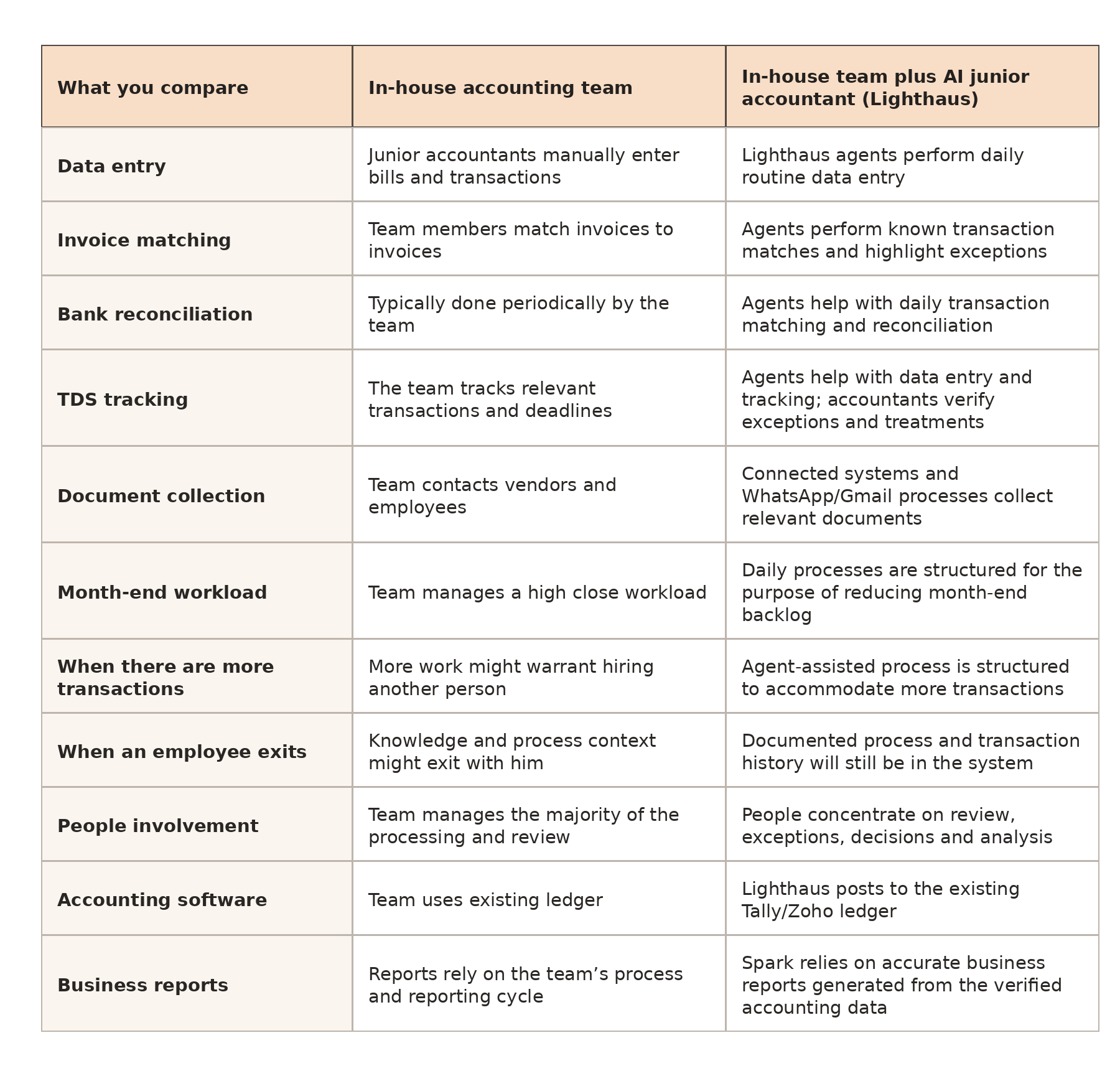
The critical distinction is not that one model contains individuals while the other one lacks them.
It lies in the fact that the second model alters how you occupy your people’s time.
1. What Exactly Is a Junior Accountant's Daily Job?
It is useful to know what the accounting team actually does to determine whether it is cost-effective to hire another accountant or go for AI-assisted accounting services.
In a rapidly growing firm, junior accountants often do the job that needs to be repeated to update accounts.
Such tasks might involve:
1. Invoicing and Billing Entry
Invoices are sent by vendors, service providers, landlords, logistics providers, and other suppliers to all companies.
Thus, a junior accountant might have to:
Receive and verify invoices.
Verify the data on the invoice.
Verify the GSTIN number of the supplier.
Enter taxable value and GST amount.
Categorize expenses according to the appropriate ledger.
Enter credit notes and debit notes.
The task of entering invoices becomes more and more time-consuming with more vendors involved.
2. Bank Transactions and Reconciliation
The organization receives and makes payments via a number of bank accounts, payment gateways, and other means. It is the job of the accountant to reconcile the bank transaction with the invoice, receipt, payment, and expense.
In other words, the ₹48,000 credited to the bank may be from a customer invoice, marketplace, or any other payment made after deductions.
It is the duty of the accountant to trace the source, reconcile with the relevant documentation, and then record it properly in the books of accounts.
3. Marketplace and Payment Gateway Reconciliation
When the business is using online marketplaces like Amazon, Flipkart, or Shopify, the reconciliation process becomes much more complicated.
The bank credit may be lower than the order value.
This is because of:
Commission on Marketplace
Charges for shipping and fulfilment
Refunds and returns
Promotions deductions
Fee from the payment gateway
Adjustments in the settlement process
A junior accountant may have to download reports, compare the transactions, and spot the difference between the order value and settlement.
4. GSTR-2B Reconciliation
Businesses will have to reconcile their purchase information against the available GST information in GSTR-2B.
The accounting team could be required to:
Match purchase bills.
Validate supplier GSTIN.
Identify bills that do not appear in GSTR-2B.
Compare taxable value and tax amount differences.
Determine possible duplications.
Raise discrepancy notice for follow-up.
Help assess ITC eligibility.
This is not merely an activity involving data entry. It needs proper records and proper accounting & taxation reviews.
5. TDS Tracking & Documentation
Based on the nature of the transactions, the team may also need to track any applicable TDS, along with supporting documents and filings.
This entails gathering data, identifying pertinent transactions, maintaining records, and handling exceptions.
6. Month-end Closing and Reporting
After the entries have been made, it is important for the accounting department to reconcile accounts, review open items, correct any inconsistencies and create the necessary financial statements.
This is where the workload tends to pile up toward the end of the month.
It is for this reason that the introduction of more transactions to the already existing manual system will make the accounting staff always busy but not necessarily up-to-date with the books of account.
The issue here is not the junior accountants doing wrong things. It is them being bogged down by mundane processing.
2. What Exactly Is the Cost of Recruiting Another Junior Accountant?
When the number of transactions increases, recruiting an additional junior accountant appears to be the most natural option.
However, the cost of recruiting an additional staff member is more than just their salary per month.
It consists of recruitment cost, onboarding cost, training cost, supervision cost, software cost and the cost of the time that other employees spend explaining everything to the newcomer.
Junior Accountant Salaries in India: An Insight
Published estimates of salaries for junior accountants in India, given in the Lighthaus research brief, put their annual salaries at about ₹1.2 lakh to ₹4 lakh. The salaries for freshers are put at about ₹1.4 lakh to ₹2.8 lakh annually.
The approximate salary range for a business is about ₹10,000 to ₹33,000 per month without other expenses associated with employment. In the business centres, the salaries may be higher.
This information is only an approximation, and it is neither a quote nor a guarantee of what an individual candidate will earn.
However, salary is not the only factor here.
Hidden Cost of Recruiting One More Accountant
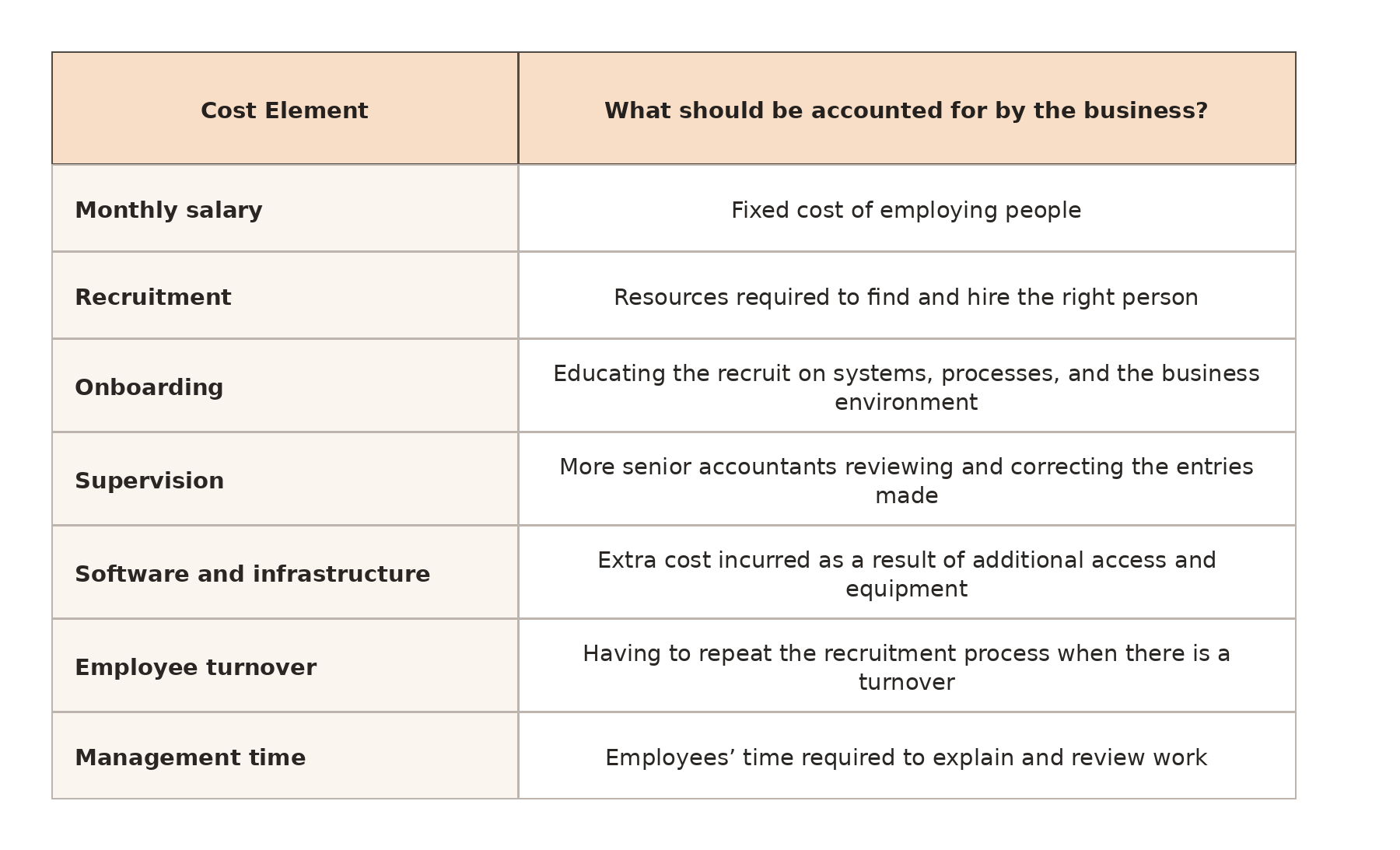
There is also the matter of capacity. If the current team is already occupied with entering data and reconciling invoices, adding another person will improve the capacity of processing without altering the process itself.
You may clear the backlog for this month, but you will find yourself facing another backlog as soon as the volume of transactions increases again.
Adding people to the process will simply add more people to the process. That's when an AI-assisted accounting system becomes useful.
3. What Is An AI Junior Accountant?
An AI junior accountant can be described as a term used to define an agent of artificial intelligence that does the job of collecting data, processing invoices, and reconciling transactions and accounts on a daily basis.
There is one major difference between an AI junior accountant as a piece of software and Lighthaus' approach.
Lighthaus doesn’t just hand your team an AI software and tell them to use it.
Lighthaus performs all the junior-level accounting tasks as a service for you.
Their agents access your business infrastructure, gather the necessary information, process any known transactions, and enter them in your existing accounting ledger. An accountant from Lighthaus then reviews any exceptions, validates and corrects suggested journal entries and deals with issues requiring professional judgment.
Your current finance team still participates in the process. In essence, you are increasing your accounting capabilities without having to deal with another piece of software.
What AI Junior Accountant Deals With
Data Collection: Collects data from integrated systems within the organization and related documentation.
Processing Invoices: Collects invoice data and processes all known accounting cases based on predefined rules.
Matching Transactions: Matches transactions in banks, invoices, payments, and other sources.
Reconciliation: Assists in reconciling banks, marketplaces, and payment gateways.
GST Data Matching: Helps in comparing purchases and GSTR-2B for any discrepancies.
Identifying Exceptions: Identifies transactions not matching the rules defined by an organization.
What Human Accountants Still Do
There is no elimination of the need for accounting expertise and judgment through the use of AI.
Human accountants still have to do the following:
Approve exceptions.
Make corrections in the case of needed adjustments.
Assess complex transactions.
Use accounting and tax judgment.
Consider ITC eligibility.
Help in financial reporting and decision-making.
Manage issues requiring expert skills.
This helps to shift the focus from data entry by humans to work that needs the expertise of the human accountant.
AI transforms the task but not the person. The junior accountant stops entering data and begins approving exceptions.
4. How Does Lighthaus Integrate with Your Current Financial Team?
For Lighthaus, the goal is never to disrupt your accounting team or make you move away from your current accounting tools. It is to reduce the amount of repetitive tasks for your team while making your accounting process more organized.
Here is how it goes:
Step 1: Integration with Your Current Business Tools
The agents of Lighthaus integrate with the systems that your business currently uses.
Based on your business processes, they can include:
Shopify.
Amazon and Flipkart.
Razorpay.
Bank feeds.
Unicommerce.
Shiprocket.
WhatsApp and Gmail for invoices and supporting documents.
The above-mentioned connections help the agents fetch necessary financial data on a daily basis. There is no need for your finance team to rely on manual fetching of documents.
Step 2: Agents Post Known Transactions
After the data has been collected, rules coded into the program make decisions on known accounting transactions and make postings to your current accounting ledger.
Lighthaus operates with the accounting software that your company uses now, which can include Tally and Zoho.
It allows you not to have to change your current accounting software and teach your financial department a whole new ledger.
Step 3: AI Decides on Exceptions
However, not all transactions are predictable. A missing invoice, an odd entry in the bank ledger, an exception on the settlement deduction, or even an unusual expense may need to be processed differently.
Lighthaus's AI proposes how such exceptions should be posted, while a Lighthaus accountant will verify, approve, or make corrections to this proposed posting.
The operating model assumes that about 4% of transaction lines will become exceptions.
Step 4: Corrections Become Part of the System
After an accountant makes an adjustment to the exception, the correction may become a rule upon its successful testing against past transactions.
It will mean that you won't have to do the same thing manually each time the issue comes up.
The system will preserve business-specific accounting context, making it able to work with recurring cases.
Step 5: Your Team Will Have More Time for Review and Analysis
Your finance team will get more time for review and analysis thanks to automated handling of repetitive tasks performed by the Lighthaus agents.
Here's what your finance team can do instead of processing transactions manually:
Review financial statements.
Understand unusual transactions.
Monitor the performance of the business.
Analyse expenses and margins.
Make decisions about cash flow.
Help business heads plan finances.
Your aim is not to increase the burden on your current team but to enhance its productivity levels.
5. What Is Different about the Everyday Accounting Tasks?
The usefulness of an AI junior accountant will be even more evident as we consider which tasks usually take up most of the accountants' time in the accounting department.
Data Inputting and Invoice Processing
In-house team alone: Employees gather bills, check data, input and categorize expenses. Lack of information triggers further inquiries.
In-house team + Lighthaus: Agents gather data from connected systems and handle known situations. Exceptions are passed on to an accountant's attention.
Bank Statement and Payments Reconciliation
In-house team alone: Accountants periodically download bank statements, reconcile data, and investigate discrepancies.
In-house team + Lighthaus: Agents collect needed bank statements and help with reconciliations daily. Discrepancies and exceptions are escalated.
Marketplace Transactions Reconciliation
In-house team alone: Employees compare marketplace reports, orders, refunds, deductions and bank credits in batches.
In-house team + Lighthaus: The process is meant to reconcile marketplace transactions one-by-one.
Reconciliation of GSTR-2B
In-house Team alone: Accountants reconcile purchase registers against GSTR-2B; find out discrepancies in respect of missing invoices.
In-house Team + Lighthaus: Agents assist in invoice matching and identifying discrepancies; accountants decide on the treatment of exceptions and ITC eligibility.
TDS Tracking
In-house Team alone: Employees track transactions, keep supporting documents and look after compliance-related data.
In-house Team + Lighthaus: Agents assist in collecting and organizing transaction data and pointing out exceptions, whereas accountants look into the applicable treatment and compliance requirements.
Month-End Closing
In-house Team alone: The end-of-month closing involves a lot of work, especially due to pending reconciliations and document collection.
In-house Team + Lighthaus: Daily processing and reconciliations are supposed to minimize the backlog, which typically builds up before the end of the month.
The difference does not consist in making every accounting decision automatically. The difference is in the fact that fewer routine actions are left to be taken care of by a person.
6. Cost vs Capacity: Hire Another Accountant or Create An AI Junior?
When looking at a business that is expanding, this decision is all about the need for more capacity and how the business wants to acquire it. Let us take the case of a business whose accounting team is having problems coping with the increased volume of transactions.
It has two major approaches to choose from.
Approach A: Hire an additional junior accountant
The company hires another person, pays the salary, offers training and assigns some processing tasks to him/her.
This approach might be the best if the company needs extra capacity internally or some additional finance expertise, or something that needs an employee to work in the organization.
Approach B: Work with the current team plus Lighthaus
The company sticks with its current finance team, but offloads the routine processing to Lighthaus.
The Lighthaus agents collect data, perform matching and do the routine postings while a Lighthaus accountant analyzes the exceptions, and the client's team continues to manage the financial information and make decisions.
Comparison of the two options is provided below.
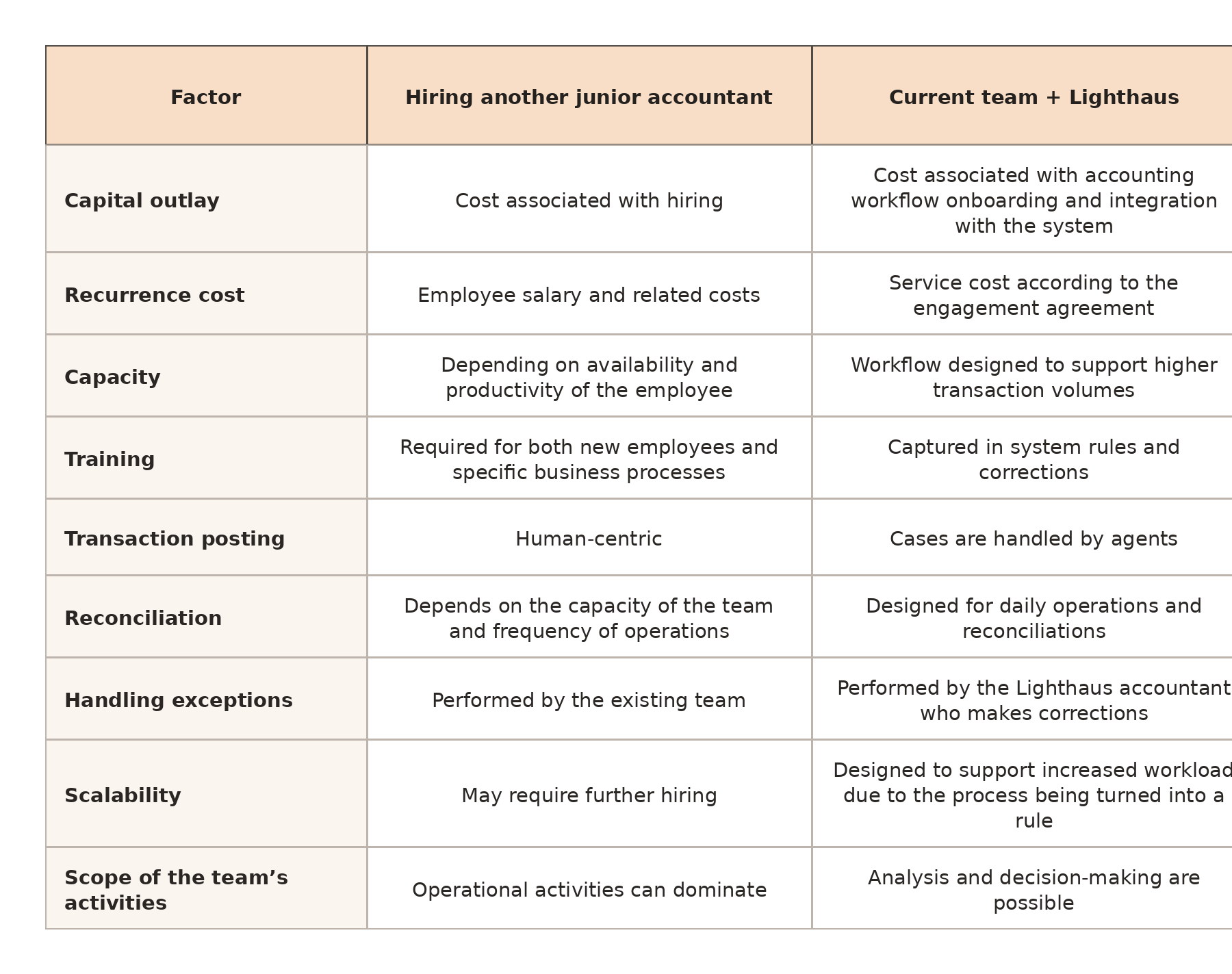
Capacity Difference: What Would It Look Like?
The following capacity target is provided in the Lighthaus research brief and describes the operating design of the agent-assisted model:
A manual accountant will serve about 10 clients. The design goal for an agent-assisted reviewer is to be able to serve about 50 clients.
This is a design target for the internal operation of the agent-assisted model and is not the client capacity guarantee or a measure of every individual engagement's productivity. Actual capacity is affected by the number of transactions, the level of complexity of businesses, frequency of exceptions and the nature of work.
The idea here is that capacity does not always have to grow through hiring more people.
When routine work becomes part of a standardized process, the same team can spend much more time on review and decision-making, rather than manual processing of each transaction.
The cost-related note: the Lighthaus pricing is not provided in this comparison. Businesses need to compare the cost of the next hire – salary, recruitment, onboarding, supervision – against the scope and cost of accounting services they will get.
7. What Will Happen to Your Existing Accounting Team?
Among all issues related to artificial intelligence in accounting, one of the main ones is about replacing those who are working in the field now.
This is not what Lighthaus suggests. AI modifies the distribution of accounting work. It does not render accounting expertise, professional judgement and context of the business irrelevant.
On the contrary, since routine processing will take less time, finance specialists will have an opportunity to devote more time to activities which add more value for the business.
More Time for Junior Accountants to Spend on Revising
Junior team members will not spend all their working hours on entries and transaction matching. They will be able to pay more attention to reviewing.
Senior Accountants Can Concentrate on Analysis
Senior team members can focus less on checking routine transactions and more on analyzing financial performance, which would aid in compliance and support business decisions.
Finance Managers Can Focus on Control and Oversight
Finance managers can concentrate more on controlling reporting quality, reviewing the financial positions, and assisting business managers rather than focusing on a constantly increasing transaction queue.
Business Owners Can Have Easy Access to Financial Data
Owners can ask questions about their financial data without having to wait for a manually prepared report. Here is when Spark, Lighthaus's WhatsApp-based assistant, comes into play.
Spark will answer questions based on verified accounting data and communicate through text and voice messages.
Here are some examples of questions a business owner can ask:
What is my real margin on the bedsheet SKU?
What are my receivables?
What was our expenditure on shipping last month?
Could you get the profit and loss statement for the previous month ready for the bank manager?
Additionally, Spark can assist in generating invoices with the previously stored GSTIN number and the appropriate GST rate. Any problem related to pricing, commissions, or some other issue that requires a personal decision is delegated to the accountant.
The result is a better integrated finance process, in which the finance team is able to concentrate on analyzing figures, instead of spending all its time generating them.
8. Do You Need An AI Junior Accountant In Your Company?
An AI-powered accounting framework is not required for all businesses. In case your company deals with few transactions each month, operates in a simple fashion and requires only basic reconciliations, your current accounting process might suffice.
However, with the growth in the number of transactions and complexity of operations, it may be time to consider alternatives to the current way of performing accounting tasks.
The AI junior accountant framework could be considered in case:
The accounting team spends several days each month reconciling transaction discrepancies.
The company handles hundreds or thousands of transactions.
The company sells on several marketplaces or payment gateways.
The company runs on different GSTINs.
The GSTR-2B reconciliation process consumes much manual labour.
The finance team finds it difficult to manage TDS transactions and documentation.
The bank and marketplace reconciliation process is frequently delayed.
The books are closed weeks after the end of the month.
You are thinking about hiring another junior accountant, whose main purpose would be the processing of the tasks that are repetitive.
Your finance department does not have much time to devote to analysis and support of business operations.
The central issue here is to understand whether your next hire will resolve a people capacity issue or just be another individual in the manual system. If the issue is about the repetitive nature of the job, rethinking the workflow seems like a good place to start.
9. Why Lighthaus Can Work with Your Current Finance Team
Lighthaus is an AI-native accounting firm created for Indian companies that require more than basic bookkeeping and compliance services. Lighthaus uses a combination of AI agents and an accountant's review to automate the routine that slows down the growing finance team.
This means that Lighthaus will:
Not require you to buy any additional accounting software: Lighthaus operates with your current Tally or Zoho ledger.
Not require you to change your finance team: You can still review and make decisions about the business.
Transaction processing on a daily basis: Agents link with business systems and process the relevant data.
Reconciliation: Bank, payment gateway, and marketplace transactions are reconciled using structured processes.
Review by humans: Exceptions are reviewed and fixed by Lighthaus Accountant.
Service that possesses the entire process: You do not need an additional tool that needs to be installed, run, and controlled by your team.
The way of operation is intended to make the system work with higher capacity when there is more and more recurrent accounting work included. The purpose is to help organizations to gain more from their accounting budget in greater amounts.

Find your gap before month-end
We'll reconcile one month of settlements against your orders. No commitment.
Conclusion: Your Next Hire in Accounting Could Be an AI
As the number of transactions grows, it is only natural to hire an additional junior accountant. However, before adding a new person to the staff, it would be useful to evaluate how much of the existing accountants’ time is spent performing specific duties.
If most of it is spent inputting bills, matching transactions, reviewing bank statements, reconciling GSTR-2B and pursuing documents, there may be a need to change the process itself.
The AI junior accountant will be able to perform all repetitive tasks within the managed accounting service framework, while you will have your current team handle the review, decision-making and judgments.
It is the concept that Lighthaus is developing. Keep the experts in-house. Get rid of repetitive tasks from their desks. By combining AI agents with an accountant review, Lighthaus will assist your finance team to become more efficient with higher visibility of your financials.
Hiring a new accountant for your business?
Instead of hiring yet another employee, first consider what your existing workflow looks like.
Schedule a free workflow review from Lighthaus and find out which of your accounting jobs can be done by our AI agents.
Clear up your business financials.
FAQs
1. What is an AI junior accountant?
An AI junior accountant is any AI agent that would perform repetitive accounting processes, for example, invoice processing, data entry, transaction matching and reconciliation. Within Lighthaus's approach, those AI agents are used within an accounting process where a Lighthaus accountant reviews exceptions and exercises professional judgement.
2. Is an AI junior accountant a substitute for an in-house accountant?
No. As per the previous point, AI agents are only capable of repetitive processing, but cannot replace accounting. Human accountants will still be involved in exception handling, corrections, assessment of complex transactions, etc. Businesses can keep their current finance team and leverage Lighthaus for processing capacity.
3. What does an AI accounting assistant do for GSTR-2B reconciliation?
AI agents could help with the identification of purchase invoices, matching them to GSTR-2B data, identifying missing records and possible discrepancies. However, the assessment of ITC eligibility, reversals and more complicated tax treatments should always go through proper accounting review.
4. Can Lighthaus integrate with our current Tally/Zoho Books?
Yes. Lighthaus is meant to post accounting entries to the books your company already uses, such as Tally and Zoho. Lighthaus does not need you to change the accounting software your company uses.
5. Who audits the entries made by Lighthaus' AI agents?
The Lighthaus agents deal with known accounting cases and flag exceptions. Lighthaus has accountants who will audit and approve or fix proposed entries that need attention. The finance people in your company continue doing what they have been doing in the past.

Amulya leads GTM and customer discovery at LightHaus. She is the authority on what exactly the market needs with respect to their financial operations and effectively translates that internally in LightHaus to ensure that the offering delivers high value to our clients
Get in Touch
We get back to you within 24 hours