AI Agent vs Agentic AI: What Is the Difference?
These two terms are increasingly being used in the discussions around Artificial Intelligence. Understanding the difference is very important when someone is trying to build something in AI or for CFOs who want to leverage AI for improving their financial workflows


In this Article
AI Agent vs Agentic AI: What Is the Difference?
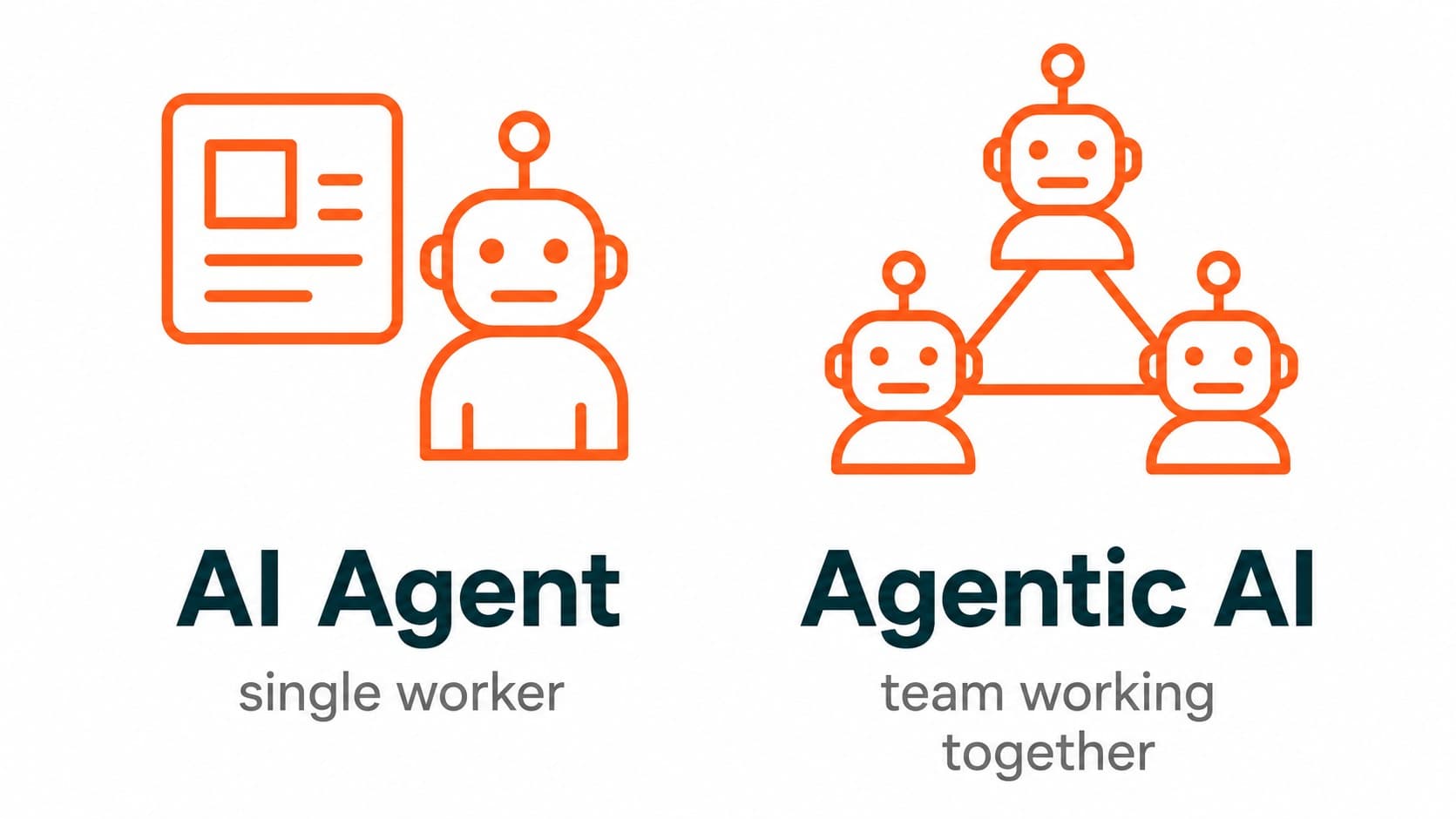
An AI agent performs a task. Agentic AI works towards a goal. In accounting, that difference decides whether software answers questions about your books or actually keeps them right.
AI agents and agentic AI are two terms that come up constantly in AI conversations right now. They sound almost identical. They are related, but they describe different levels of capability.
The simplest way to hold the difference in your head is this: an AI agent performs a task. Agentic AI works towards a goal.
IBM defines an AI agent as a system that can autonomously perform tasks, design workflows, use tools, and interact with external systems. Agentic AI takes that further. It coordinates agents, tools, and data to reach a broader objective.
What Is an AI Agent?
An AI agent is an AI system built to perform a task with some degree of autonomy.
Imagine you tell an accounting AI agent: "Read this invoice and enter it into Tally."
The agent reads the invoice, identifies the vendor, extracts the relevant details, decides the accounting treatment, creates the journal entry, and enters it into the accounting system. The task was defined. The agent executed it.
Modern AI agents can use tools, pull external information, make decisions, and take actions. They do not just generate a response.
That is what separates an AI agent from a traditional chatbot. A chatbot tells you how to record an invoice. An AI agent records it.
What Is Agentic AI?
Agentic AI describes a broader system that pursues a larger objective. It plans. It breaks the objective into smaller tasks. It coordinates different agents and tools. It adapts based on what happens during execution.
Now imagine you tell an agentic accounting system: "Keep my books updated."
That is not one task. The system has to work out what needs to happen. It might:
Identify new invoices
Match invoices against payments
Reconcile bank transactions
Check marketplace settlements
Compare GST data
Flag discrepancies
Decide which transactions it can handle on its own
Send exceptions to a human reviewer
Update the books once those exceptions are resolved
This is where agentic AI gets powerful. The system is not waiting to be told what to do next. It is working towards an outcome.
IBM characterises agentic AI by goal-driven behaviour, autonomous decision making, tool use, planning, execution, and orchestration across multiple agents and systems. Microsoft describes agents in similar terms: systems that make decisions, invoke tools, and take part in workflows independently or alongside other agents and humans.
The line between the two is not absolute. The terminology is still settling, and different companies use these words differently. What actually matters is the architecture underneath and the level of autonomy it supports.
How Agentic AI Works
An agentic system usually runs a loop:
Receive a goal.
Gather information to understand the current state.
Reason about what needs to happen.
Decompose the objective into smaller tasks.
Select the right tools or agents.
Execute the actions.
Evaluate the results.
Continue, change direction, or escalate to a human.
This coordination layer is usually called orchestration. It manages the agents, workflows, tools, data, memory, and execution across the system.
Why This Matters in Accounting
Accounting is a strong use case for agentic AI, because accounting is not one task. It is a connected system of thousands of transactions, rules, reconciliations, exceptions, approvals, and decisions.
Take a typical ecommerce business. A customer places an order. The payment is collected. The marketplace deducts its fees. The customer returns the order. A refund is processed. The marketplace settles what is left. GST has to be accounted for. Inventory has to be reconciled. The ledger has to reflect all of it correctly.
A single AI agent could automate one piece of that. One agent extracts invoice data. Another classifies transactions. Another reconciles payments. Another spots discrepancies. Another runs GST checks.
But the hard part is not any one of those pieces. The hard part is connecting them.
That is the shift agentic architecture makes possible. Instead of asking "What task should the AI perform?", the system starts from "What needs to happen for the books to be accurate and up to date?"
That is a much bigger question — and a much more useful one.
Agentic AI Still Needs Humans
Agentic AI does not mean removing people from the process. In accounting, that distinction matters more than almost anywhere else.
Some transactions are routine. Some are ambiguous. Some exceptions need real accounting judgement.
A well-designed agentic system processes the routine work automatically and surfaces the exceptions that need a human. The human becomes part of the workflow instead of manually supervising every transaction.
Human-in-the-loop design is already recognised as a core part of agentic automation, especially at the points where validation or judgement is required.
The result is a different model of automation. The AI handles the volume. The human handles the judgement.
AI That Explains the Work vs AI That Does the Work
For an accounting system, the goal should not be AI that answers accounting questions.
A system that tells you your GST liability is useful. A system that investigates the underlying transactions, reconciles the data, identifies exceptions, works out what needs correcting, and prepares the books is a different category of useful.
That is the real distinction: AI that explains the work versus AI that performs it.
It is also why the agent-versus-agentic question matters for any business evaluating AI automation. An AI agent automates individual pieces of a workflow. Agentic AI connects those pieces around a business objective.

Find your gap before month-end
We'll reconcile one month of settlements against your orders. No commitment.
Where LightHaus Fits
This is the direction we are building in at LightHaus.
We are not building AI that talks about your books. We are building AI that works on them.
The objective is to connect the pieces of the accounting workflow so transactions are processed, reconciled, checked, and escalated when human judgement is needed.
The long-term opportunity is not automating accounting tasks. It is an accounting system that understands the state of your books, decides what needs to happen next, executes it, and keeps working towards books that are accurate and current.
That is the difference between an AI agent and agentic AI.
An AI agent performs a task. Agentic AI works towards a goal.
And in accounting, the goal is not to answer questions about your books. The goal is to keep your books right.
Sources and Further Reading

Amulya leads GTM and customer discovery at LightHaus. She is the authority on what exactly the market needs with respect to their financial operations and effectively translates that internally in LightHaus to ensure that the offering delivers high value to our clients
Get in touch
We get back to you within 24 hours