Traditional vs AI-based Accounting Firm: How Does It Impact?
Find out the differences between traditional and AI-based accounting firms. Check how Lighthaus leverages AI agents and accountant review to handle daily books.


In this Article
Traditional Vs. AI-led Accounting Agencies: What Does It Imply for Indian Companies?
The deadline for GST return filing is on the 20th. Yet, accounts for the previous month have not been closed.
The sales data is available. Data on bank statements is available. All the transactions from the marketplace are recorded in different documents. The accountant is after you regarding the lack of invoices when you do not even know the income of the previous month.
Such is the reality of many small and medium-sized businesses.
A regular accounting firm would provide you with bookkeeping, GST return filing, calculation of TDS payments, and accounts in the last month. Yet, with the increase in the number of transactions, the period between the completion of the transaction and its registration in accounts will take more time, and it may become a problem.
Here comes the role of an AI-led accounting agency.
Difference between Traditional and AI-Native Accounting Firms
In the case of a traditional accounting firm, accountants gather the financial data, record transactions, reconcile books, and generate reports based on a periodic schedule.
AI-native accounting firms include agents, rules, and humans in the cycle. Transactions are performed every day, while known cases are managed using rules and exceptions are referred to an accountant for decision-making.
Here is a comparative analysis of the two types of accounting firms.
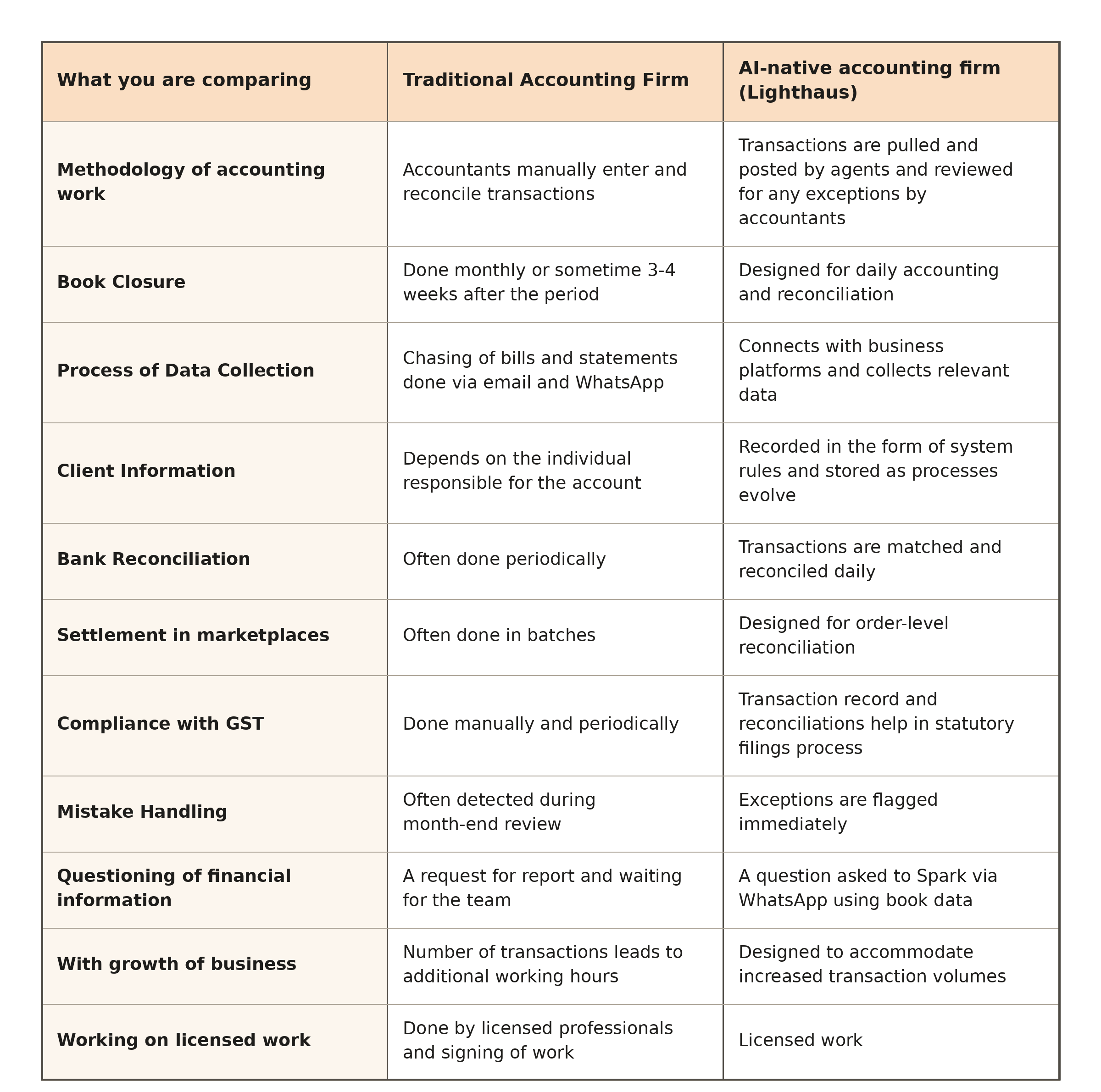
Significant difference lies here: an ordinary accounting firm markets its accounting capability based on man-hours. In the case of an AI-based accounting firm, the process is developed in relation to its output.
1. How Does a Traditional Accounting Firm Operate?
Traditional accounting services have been around for many years to serve the requirements of Indian businesses. They assist in bookkeeping, making financial statements, filing GST returns, handling TDS and statutory requirements of a company.
The process is well known. A business firm shares its invoices, bank statements, expense details, and other financial papers with its accountant. The accountant then analyses the data, enters the transaction details into accounting software, for example, Tally or Zoho Books and prepares the required financial statement.
A typical flow of events in accounting could be as follows:
Step 1: Financial documents collection
The accounting team asks for sales invoices, purchase bills, bank statements, expense details, and other documents.
Step 2: Entering transaction details
The transaction details are entered by the accountant, categorized, posted on the ledger and matched with supporting documents.
Step 3: Account reconciliation
Bank statements, payment gateway transactions, marketplace transactions, vendor balance etc. are compared with accounting entries.
Step 4: Preparation of statutory forms
The team prepares GST returns, TDS related documentation, and other compliance filings.
Step 5: Closing and reporting
Once all the entries and reconciliation is done, the business gets their financial statements and reports.
This process could function effectively if the transactions of the business are predictable and the accounting process required by the business is simple.
The problem arises when the business starts growing faster than the accounting process.
Let’s consider the case of a D2C brand selling through Shopify, Amazon, and Flipkart. There will be many transactions like orders, returns, refunds, deduction from the payment gateway, fees from marketplaces, and other similar entries. In a multi-location business there will be many bank accounts, GSTINs, vendors, branch level costs and many more.
All these entries have to be captured, processed, and reviewed by the accounting team.
Consequence? The books start falling behind the business.
2. Why Do Conventional Accounting Companies Tend To Provide Delays In Books?
Delays in books don’t mean that the company lacks accounting skills or an efficient accountant.
The issue usually lies in the structure. Conventional accounting is very dependent on manpower. The more transactions there are, the more invoices, reconciliations, and exceptions need to be taken care of.
Lighthaus identifies three main challenges that prevent the people-first accounting model from providing up-to-date books.
The People Trap: More Work Equals More Time
Take a business doing 500 transactions in a month.
Now picture their transaction load increasing by two times.
More invoices, payments, banking activities, deductions, credit memos and reconciliation tasks will need to be carried out by the accounting department. With most of the work done manually, this means more people or more time.
This poses a problem with capacity. The conventional approach is based on the availability of accountants. Regardless of how experienced the team is, there is a limit to what they can accomplish in a certain period of time.
Real-time accounting needs much more processing power compared to a one-time-a-month accounting process. As per Lighthaus's business premise, real-time accounting could be five times more laborious than one a month under a manual system.
This is challenging to manage with a subscription pricing model.
The Knowledge Trap: Business Context is Locked in Individual's Mind
Every company has its own accounting context.
Certain deductions from a particular market might require specific treatment. Certain suppliers might have a unique billing schedule. Repeated expenses might require certain classification.
Through time, the accountant acquires all these bits through experience.
What if that individual moves on? The new individual has the access to the journal, but not the rationale behind each record. The business will waste time educating and re-establishing context.
The issue was never about the individual. It was about the environment surrounding him/her.
When accounting knowledge is stored in the individual's head, it becomes difficult to achieve continuity.
The Technology Trap: Software Won't Necessarily Solve the Workflow
Almost all successful enterprises have accounting software. Tally and Zoho Books are some tools that ensure bookkeeping records are maintained, transactions are recorded, and financial reports are generated. However, accounting software will not necessarily ensure all invoices are collected, all deductions in the marketplace are captured or reconciling transactions is done automatically.
There will always be someone who needs to shift data from one system to another, check for inconsistencies and determine the way forward when it comes to recording transactions.
Introducing yet another system will speed up the process of doing things, but at the same time, it will bring yet another system into the workflow.
3. What Is an AI-Native Accounting Firm?
AI-native accounting firm is an accounting service designed on the basis of AI agents, automation, rules and human accounting management.
Unlike using AI in addition to an existing manual workflow, in the AI-native accounting firm, the workflow design is made in accordance with technology from scratch.
In such a way, the AI agent is able to perform routine tasks like data acquisition, invoice matching, entry posting and discrepancies finding. The accountants make their judgments in exceptional cases.
A key difference:
AI-native accounting firms are different from AI accounting tools.
While an AI tool could assist in extracting invoices or automating data entry or even reconciling the bank account, the process would require your finance department to manage it, fix any bugs, and be responsible for the resulting books.
The accounting service by an AI-native accounting firm involves providing the service directly.
Your accounting is outsourced to the firm; it owns the process and the end product.
With Lighthaus, this means that you will not have to spend extra on the software license, a new employee for your finance department, or an additional team managing the automation.
You will receive a service that includes both technology and accountability.
4. How Lighthaus Works as an AI-Native Accounting Firm
The accounting operations of Lighthaus have been designed keeping only one thing in mind – automation takes care of the repetitive tasks whereas the judgemental work needs to be done by accountants.
This is how it works:
Step 1: Connect your current business systems
Connectors of Lighthaus link with the systems currently being used by your business.
According to your requirements, it can include:
Shopify, Amazon, and Flipkart.
Razorpay and other payment gateways.
Bank feeds.
Unicommerce and Shiprocket.
WhatsApp and Gmail to access bills and documents.
The goal is to get the relevant transaction data into the accounting process without needing anyone to compile files manually.
If you run a D2C business that is using many sales channels then it will be required to account for orders, cancellations, returns, refunds, delivery charges, marketplace fees, and settlements.
Without waiting till the end of the month, the process will collect the relevant information on a daily basis.
Step 2: Rules Manage Known Accounting Scenarios
After gathering the data, Lighthaus uses rules in the form of codes that manage known accounting scenarios.
The rules process transactions and make entries into the accounting ledger of your business, which you might already be using, such as Tally or Zoho Books.
Why is it significant? The reason is that Lighthaus does not force you to switch your accounting software.
Your business can use the old accounting ledger while Lighthaus agents perform the job for you.
Step 3: AI Identifies & Works Its Way through the Exceptions
Not all transactions fit a predictable pattern. A lost receipt, an oddity in the bank statement, a deduction from a marketplace, or something you can’t figure out may require further examination.
This is where artificial intelligence steps in. Artificial intelligence agents provided by Lighthaus examine the exceptions and make recommendations as to what should be done about the exception.
The software is engineered with a view towards having around 4% of all transaction lines be exceptions, and not having a person check every transaction line.
Step 4: Exceptions Turn into Better Rules
When an accountant resolves an exception, it does not have to end with this one individual.
The exception can become a new rule once tested on historic transactions.
That way, the system can recognize future occurrences and minimize the number of times this exception needs to be dealt with manually. In the course of time, the system will become more efficient through incorporation of business knowledge into the workflow process.
Step 5: Accountants' Review and Lighthaus' Ownership of the Result
AI manages transaction volumes. Accountants check exceptions and use their expertise. Lighthaus owns the accounting process: the daily bookkeeping, reconciliations, statutory processes and production of financial statements.
For audit and any other licensed work, licensed CAs from Lighthaus' partner network sign off on the work.
It is not about taking away the human factor from accounting, it is about making this factor more accessible when it really matters.
5. What Changes When Your Books Are Updated Daily?
What really changes with artificial intelligence-native versus traditional accounting is not how fast transactions are recorded.
It’s what the business can do with its data. With accounting books updated only monthly, the entrepreneur frequently makes decisions based on numbers describing the business that was weeks ago.
When accounting books are being daily updated and reconciled, the financial data becomes valuable for making operational decisions.
Let’s consider three cases when it helps.
Daily Bookkeeping and Reconciliation
An expanding business might receive cash from various sources. One is payment from a customer via Razorpay. Another could be a payment from Amazon after fees have been deducted. There could also be a refund for a Shopify sale. Lastly, a bank payment could come in with no clear reference.
Each one of these transactions needs to be reconciled with the relevant record.
If this process is carried out on a monthly basis, differences will pile up.
Daily bookkeeping and reconciliation will help spot mistakes before they happen.
GST Compliance & ITC Transparency
GST compliance goes beyond timely filing of GSTR-1 and GSTR-3B.
One must also ensure correct documentation regarding sale details, purchase invoices, classification of taxes, and ITC calculation as well.
For instance, a business operating with multiple GSTINs and suppliers would need to manage:
Outward supplies and their respective taxes.
Purchase invoices and the GSTINs of the suppliers.
GSTR-2B data in connection with the purchases.
ITC entitlement and reversals that are needed.
Tax liabilities at all applicable GSTINs.
If the accounting records are updated in a systematic manner, it will become easier for the business to prepare its GST returns.
The workflow of Lighthaus makes this possible while ensuring that statutory compliance requirements are met along with exception handling by accountants.
Improved Financial Transparency
A business owner does not need to wait till the end of the month to understand the current status of his/her business. Let us take an example of a D2C company that sells bedsheets from its own website as well as through marketplaces.
It appears that the selling price is good and hence profit will be good. But there is a lot more which will affect the actual margin.
Here you will also have to consider:
Discounts offered.
Returns.
Marketplace commissions.
Gateway fees.
Fulfilment costs.
Cost of products & packing.
With no reconciled books, the founder could be considering revenue/Gross sales and not actual margins.
This is the difference between having accounting books and financial transparency.
6. What is Spark, and How does It Assist the Business Owner?
Information is meaningful only when one has access to it and understands it. However, obtaining answers to questions from one's accountants can entail asking for a report and interpreting numbers after the report has been prepared.
This issue has been solved by Lighthaus in the form of Spark, an assistant of Lighthaus available to clients on WhatsApp.
The business owner can type or speak to Spark in his/her own language for any query.
The response will be provided based on verified accounting data and not assumptions made from partial data.
For instance, one can ask:
What is the true margin on the bedsheet SKU?
How much have we spent on shipment in the past month?
What are our outstanding receivables?
Can you provide last month's P&L statement for the bank manager?
Spark will also help generate documents such as invoices based on saved GSTIN number and correct GST rate.
7. Is the AI-Native Accounting Model Already in Play Worldwide?
The idea of an AI-native accounting model is not just a concept. Other firms are currently trying out accounting services and processes driven by AI.
Some cases will illustrate the evolution of the category.
Pilot: The company from the US offers bookkeeping, tax, and CFO services for startups and SMBs. Pilot’s unique model is based on combining technology and financial experts reviewing the accounts and aiding decision-making.
Current and Thrive Holdings: Thrive Holdings is pouring resources into the conversion of professional services firms to use artificial intelligence in their operations. The company declared over $2 billion in financing in August 2026 at a $12 billion valuation. The accounting platform of Thrive Holdings, called Current, has over 50 firms and over 2,000 professionals.
Basis: Basis creates artificial intelligence agents for accounting professionals. The firm declared a $100 million Series B funding round in February 2026 with a valuation of $1.15 billion. This is another case of funding into AI in accounting, though Basis is a technology company and not an accounting firm like Lighthaus.
The companies are operating in varied markets with varied models. They do, however, signify a change in trend; accounting practices are beginning to be redesigned to suit AI rather than integrating automation into their processes.
Lighthaus has taken into account the challenges faced by the Indian business world: GST, TDS, various GSTINs, Tally, Zoho, and settlement of marketplaces.
8. Which Accounting Model is Right for Your Growing Business?
An AI-native accounting firm does not suit all businesses. When a business is dealing with simple operations, less transaction volume, and easy reporting requirements, then an old-fashioned accounting firm is good enough.
However, as a business grows, the accounting model must grow along with it.
If you should choose an AI-native accounting firm, you may do that if:
Your business deals with more than 200 transactions each month.
You are selling in many marketplaces, such as Shopify, Amazon, and Flipkart.
You deal with many GSTINs or work in various states.
Settlements via marketplace and reconciliation via payment gateway consume too much time.
Books are always closed several weeks after the end of a month.
Your finance department wastes a lot of time on entering data and collecting documents.
You are not sure of the accuracy of your books.
You want to know your margins, cash flows, and profitability more often.
You need to get answers regarding financial performance without waiting for a monthly report.
The key issue is not whether you should dismiss your current accountant.
It is whether your accounting model can handle your growing business.
9. Why Lighthaus is Creating a New Accounting Model for India
At Lighthaus, we think that organizations shouldn’t have to decide between the efficiency of technology and the accountability of professionals in the accounting field.
Accounting services were traditionally designed in the way where the work was done by people. The accounting software allows teams to do this work. Lighthaus provides a combination of both approaches in our AI-first accounting service that owns the end-result.
Our model is based on five key points:
Daily books instead of month-end surprises
We create a workflow where bookkeeping and reconciliation take place on a daily basis, thus providing organizations with more accurate financial records.
Your existing accounting software remains
Lighthaus operates in the ledger of your organization, whether it's Tally or Zoho. No need to change your accounting system in order to transfer your accounting to Lighthaus.
AI processes volume; accountants process judgment
Agents process known transactions and highlight exceptions. Accountants review, approve and fix the exceptions that require human expertise.
Business expertise is preserved within the system
Any fixes are tested and transformed into rules, making it easier for the system to handle similar cases going forward.
You get a service rather than another piece of software
The Lighthaus approach assumes the responsibility for the entire accounting process. There is no need for your team to learn, manage and monitor yet another software application.
Our business model is optimized to increase efficiency of the accounting process as transaction volumes increase. The goal is to stretch your monthly accounting budget even further.

Find your gap before month-end
We'll reconcile one month of settlements against your orders. No commitment.
The Future of Accounting Is Not About Making the Job Less Relevant. It’s About Making It Better.
The distinction between a traditional accounting firm and an AI native one lies in the nature of work being done there.
While a traditional approach relies on people to gather, input, match, and reconcile information, an AI native approach employs agents and rules for the processing of repetitive tasks on a day-to-day basis and accountants’ involvement only in exceptional cases, judgement and review.
But for a growing Indian company, it means much more than merely efficient bookkeeping.
It means improved visibility into GST transactions, more accurate reconciliation, clearer and more precise financial statements and the possibility of making decisions based on more relevant numbers.
We at Lighthaus create an AI native accounting firm for companies that have already outgrown the monthly accounting cycle.
Your books should stay relevant to your business. Gain transparency into your company’s finances.
Are you ready to get insights into what is going on with your books? Contact Lighthaus or book a free books health check today.
FAQs
1. Define AI-native accounting firm.
AI-native accounting firm is an accounting service company whose operations incorporate AI agents, automation, structured rules, and human review. The use of technologies allows carrying out repetitive accounting tasks while accountants will have to review exceptions, make decisions based on judgment and supervise the results of accounting.
2. How is AI native accounting firm different from a traditional accounting firm?
Typically, a traditional accounting firm operates through the manual collection of the necessary documents and entering the transactions and reconciliation by means of software assistance performed by accountants. AI-native accounting firms work with connected systems, agents, and coded rules to automatically process routine transactions daily, and review exceptions and important decisions made by accountants.
3. Is my financial data secure in the AI accounting firm?
Businesses need to consider the security policy of the selected accounting service company, the access of its personnel to the financial information of the client company, the confidentiality and the methods used to protect this kind of information. In particular, businesses are recommended to ask the provider how they connect to their system and whether anyone can access their records.
4. Do I have to leave Tally/Zoho if I change to Lighthaus?
No. The software will connect to the ledger that your company currently uses, including Tally or Zoho. The agents of Lighthaus do not create their own ledger; instead, they work with the ledger you currently have and perform transactions and entry of transactions to your ledger.
5. Is the AI going to replace accountants in AI-native accounting firms?
No. AI will take care of the repetitive and voluminous tasks such as collecting data, reconciling transactions and entering transactions into the ledger. The accountants will review exceptions and correct errors. Any audit work done by licensed CAs in Lighthaus' partner network.

Amulya leads GTM and customer discovery at LightHaus. She is the authority on what exactly the market needs with respect to their financial operations and effectively translates that internally in LightHaus to ensure that the offering delivers high value to our clients
Get in Touch
We get back to you within 24 hours