Your Supplier Didn't Pay GST. Can You Still Keep Your ITC?
The Supreme Court confirmed that businesses must reverse Input Tax Credit (ITC) if suppliers fail to remit collected GST to the government. Although the law permits reclaiming this credit once the supplier discharges its tax liability, practical gaps exist since current rules lack mechanisms for payments made via audits or DRC-03 forms. Until system updates bridge this gap, businesses should handle notices strategically by verifying vendor compliance, reversing credits under protest when necessary, and maintaining thorough documentation.


In this Article
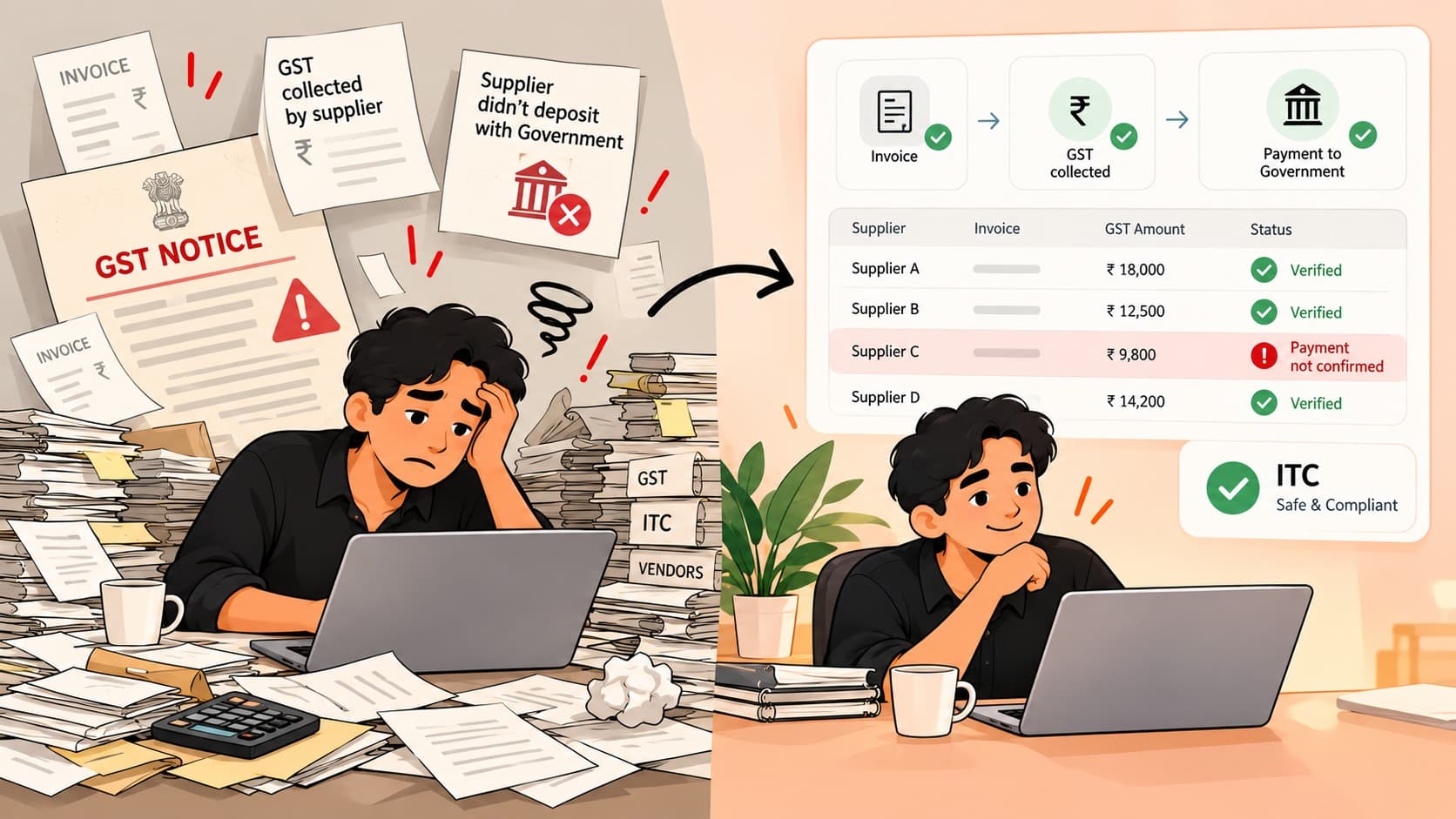
Before a business claims input tax credit (ITC) on a purchase, it usually runs a few basic checks. Is the supplier registered under GST? Did the goods actually arrive? Is there a proper tax invoice? Does the invoice show up in GSTR-2B? Once all of that is in place, the business pays the supplier in full, including the GST on the bill.
Most finance teams assume that is enough. But months later, a notice can arrive saying the credit must be reversed. The reason is not something the buyer did wrong. It is that the supplier collected the tax and never paid it to the Government.
Say a D2C brand buys packaging worth ₹10L from a vendor and pays ₹1.8L as GST on top. The brand claims the ₹1.8L as ITC. A year later, the department finds that the vendor kept that tax. It now asks the brand to reverse the ₹1.8L with interest, even though the brand paid every rupee it owed.
In July 2026, the Supreme Court confirmed that this rule is valid. This article explains what that means, where the law still leaves honest buyers stuck, and what you can do if you receive such a notice.
The rule, and why it feels unfair
Section 16(2) of the CGST Act lists the conditions a buyer must meet before claiming ITC. Most of them are about the buyer's own purchase, like holding the invoice and receiving the goods. The buyer knows these facts and can prove them.
Clause (c) is different. It says the tax on the purchase must have actually been paid to the Government. That is a fact about the supplier, not the buyer. And in most cases, the buyer has no way to check it.
The reason is simple. GSTR-2B only shows that the supplier reported the sale. It does not show whether the supplier paid the tax on it. Even the supplier's GSTR-3B does not prove it, because GSTR-3B is a summary of the whole month and not a list of invoices. The Gujarat High Court accepted this point itself in the Maruti Enterprise case. So the law asks the buyer to make sure of something the buyer cannot see.
What the Supreme Court decided
A group of businesses, led by Maruti Enterprise, challenged Section 16(2)(c) in the Gujarat High Court. They argued that an honest buyer should not lose credit because a supplier defaulted. The High Court disagreed. One of the businesses, Bhandari Scrap Traders, then appealed to the Supreme Court.
On 24 July 2026, the Supreme Court dismissed the appeal. But it did not simply refuse to hear the case. It gave reasons, and that makes the decision carry much more weight.
The reasoning had two parts. First, the Court said GST is built differently from the old Delhi VAT law, so earlier rulings that protected honest buyers under VAT do not carry over. Second, and more important, it said the buyer is not left without a remedy. Section 41 of the CGST Act asks the buyer to reverse the credit when the supplier has not paid, and lets the buyer take it back once the supplier pays. In the Court's words, the buyer can re-avail the credit "after the supplier-dealer is made to discharge the tax liability".
So the rule stands mainly because the law promises the buyer a way to get the credit back. Keep that in mind, because the next section shows where that promise falls short.
The question is not fully closed everywhere. The Tripura High Court took the opposite view in the Sahil Enterprises case, and the appeal against that ruling is still pending in the Supreme Court.
The Gujarat judgment also has two lines that help honest buyers, though they get little attention. The court said credit should be denied only if the buyer knew, or ought to have known, that the purchase was linked to tax fraud. It also told the Government to build a system that tracks supplier payments against each invoice in real time, so that honest buyers are protected from their vendors' defaults. A court would not ask for such a system if it believed one already existed.
The gap: paying is not the same as filing
Section 41 says the buyer can take the credit back when the supplier pays the tax. But the rule that puts this into practice, Rule 37A, covers only one situation. That is when the supplier did not file GSTR-3B at all.
In that case, the system works well. The buyer reverses the credit. When the supplier later files GSTR-3B, the buyer can see it in GSTR-2A and takes the credit back. No one's permission is needed.
The trouble is that suppliers often pay in other ways. A supplier may file GSTR-3B but short-pay, and the shortfall is caught later in an audit, an investigation or a scrutiny. The supplier then pays through a form called DRC-03, or the department recovers the money through an order. In all of these cases, the supplier has paid. But the payment never shows up in the buyer's GSTR-2A, so the buyer has nothing on record to point to.
In other words, the law gives the buyer the right to take the credit back, but there is no counter where the buyer can collect it.
This is exactly the case the Supreme Court described. It said the buyer can re-avail credit after the supplier "is made to" pay. A supplier is made to pay through audits and recovery proceedings, which is precisely where Rule 37A does not reach. So the right exists, but the process to use it has not been written yet.
What you can do if you get a notice
Notices under Section 16(2)(c) usually come up in four situations, and each one needs a different reply.
1. The supplier never filed GSTR-3B
This is the case Rule 37A was written for, and it works. Reverse the credit within the time limit, which is 30 November of the following year, and take it back once the supplier files. If the department is also asking for interest, check whether the Rule 37A deadlines were actually crossed before you agree to pay it.
2. The supplier's registration was cancelled with a backdated effect
This is not really a clause (c) case, because the issue is not unpaid tax. Say this clearly at the start of your reply, so it is clear which condition you are defending. Your argument is that every condition was met on the day you claimed the credit, when the supplier's registration was active on the portal. A cancellation made later, with a backdated effect, should not take away credit you claimed correctly. Some courts have accepted this argument.
3. The default is further up the chain
Clause (c) only covers the tax on your purchase from your own supplier. If your supplier paid their tax but their supplier did not, clause (c) does not apply to you.
Sometimes the department also questions whether the purchase happened at all. That is a separate allegation, and it is better answered separately. Keep proof like e-way bills, lorry receipts, weighment slips, bank payment records and, where possible, photos of the goods being unloaded.

Find your gap before month-end
We'll reconcile one month of settlements against your orders. No commitment.
4. The supplier paid later, after an audit or investigation
This is the gap described above. Here you can make two arguments. First, your right to take the credit back comes from Section 41, and it is triggered by payment, not by filing a return. Rule 37A covers only one kind of case, so the lack of a process for other cases should not take away a right the law gives you. Second, on the time limit for claiming ITC, you are not making a fresh claim. You are taking back credit you already claimed on time, and Rule 37A itself sets no outer deadline for this.
In practice, these four steps will keep you on safe ground until the law catches up:
If the department points to a specific invoice, reverse the credit with interest "under protest" at the DRC-01A stage itself. This avoids a long dispute.
Keep track of the supplier's case and note how and when it ends.
Once the supplier pays, take the credit back in your GSTR-3B and keep proof of the supplier's payment.
At the same time, write to your jurisdictional GST officer. Attach the supplier's DRC-03 or DRC-07 and show which of your invoices it covers.
The last step is the most important one. It turns a silent re-claim into a disclosed one. If the department later accuses you of hiding facts, your letter is the complete answer.
What should change
It was not always like this. When GST started in 2017, the law had a full two-way system. The buyer could add a purchase that the supplier had not declared. The system then matched both sides and told both parties about any mismatch. If the supplier corrected it, the buyer got the credit back automatically, along with the interest. This system was never switched on, because it needed three returns every month and was too heavy for businesses. It was removed from the law in October 2022.
Today we have the Invoice Management System (IMS), which went live in October 2024. It lets a buyer accept, reject or keep pending the invoices a supplier uploads. But it does not let the buyer add an invoice the supplier left out. So the buyer can sort what the supplier gives them, but cannot raise a flag of their own.
There is a simple fix that does not need a new system. IMS could let buyers add entries. If the supplier does not reject the entry within a set time, it could be treated as the supplier's own declaration. If that tax then goes unpaid, the law already allows the department to recover it directly from the supplier, through refunds or bank accounts. That recovery should happen before anyone goes after the buyer.
The GST Council is expected to take up this issue, and there is a fair chance of relief for honest buyers. Until then, the ITC you claim is only as safe as your supplier's compliance. For a growing D2C brand or SME, that means watching which vendors file and pay on time, flagging credit at risk early, and keeping the proof ready before a notice arrives.

Bringing financial clarity to business owners is Samhith's life goal after graduating from IIT & ISB.
Get in touch
We get back to you within 24 hours