Monthly Bookkeeping for Businesses: 19 Essential Tasks to Do Every Month
Learn the monthly accounting tasks businesses should complete, from bookkeeping and bank reconciliation to GST, TDS, cash flow, and financial reporting.


In this Article

Monthly Bookkeeping for Businesses: What Aspects of Bookkeeping Require to be Performed Every Month?
Lighthaus is a modern accounting firm which aims to improve bookkeeping using modern AI-led practices to solve the problems of traditional manual accounting. But, before that, in this blog, we aim to see what a routine, monthly bookkeeping usually entails and why it is important.
Having a business carries a heavy burden of monthly commitments. Monthly payroll has to be made. Receivables have to be collected from customers. Payments are to be made to suppliers. The GST and tax obligations have to be settled. And in the midst of this, someone has to understand whatever took place in monetary terms during the month.
Many companies wait for the end of the financial year to start accounting operations. Invoices are collected later. Bank transactions are reconciled long after they happen. Expenses are analysed only on the brink of tax filings. The financial statements are issued only at the request of investors, creditors, auditors, or management teams.
The problem is that your business operates every day, not just once a year. This is why the concept of monthly accounting appears. Monthly accounting offers businesses the possibility to keep their financial matters up-to-date and do such important activities as reconciling transactions, monitoring receivables and payables, along with making reports concerning the financial status of the business.
In the year 2026, the situation will become more crucial. With accounting technology continuously automating several tasks such as product data entry, reconciliation, and many repetitive functions, business owners require their accounting departments to provide extra visibility and insights. However, using different unconnected tools creates additional challenges since data gets disconnected among spreadsheets, banking systems, payment processors and accounting systems.
How many things should be handled every month? Let's figure this out.
What Is Meant by Monthly Accounting Services?
Monthly accounting services refer to regular accounting and bookkeeping tasks that are carried out throughout the year to ensure that a company's financial information is accurate, kept up-to-date, and relevant.
Depending on the company, its organisational form, turnover, as well as its cooperation with an accounting service provider, monthly accounting services may include the following:
Recording sales and purchases of goods and services
Recording business expenses
Reconciling bank accounts and credit cards
Tracking receivables
Tracking payables
Some aspects of payroll accounting
Accounting and reconciliation of GST
Calculating TDS and ensuring compliance
Classifying business expenses and making payments
Tracking fixed assets
Preparing monthly profit and loss statements
Preparing financial balance sheets
Monitoring cash flow
Preparing management reports
Performing financial analyses
The exact scope may differ from one company to another but generally remains the same. A small professional services firm is likely to have less complicated transactions on a monthly basis. Meanwhile, an e-commerce organisation may need a marketplace reconciliation process, inventory accounting, and processing of payments. Also, the needs of a growing company include a variety of management reports, cash flow forecasts, and department-level analysis.
In What Way Can Accounting Help Different Companies Every Month?
Operating a monthly accounting service is not merely about organizing the documents. It triggers a financial feedback system.
Revenue is received → recorded → reconciled → receivables are billed → expenses are recognized → profit is analyzed → cash flow is monitored → business decisions are improved.
All this makes it possible for business owners to form a clearer understanding of the business's activity every month.
1. Understanding Business Finances Having good sales does not imply having good cash flow. Even if invoices worth ₹50 lakh have been issued, this does not mean the firm has ₹50 lakh in the bank. Having accounts every month enables the distinction between important terms such as: Income, Profit, Cash, Receivables, Payables, Taxes, and Expenses. Understanding these terms can significantly impact business decisions.
2. Many issues are much easier to solve when they are still small An accounting mistake found at the end of the month is simpler to rectify than the same mistake occurring in the sixth month of the year. This applies in particular to:
Duplicate payments
Unreceived invoices
Unmatched entries from the bank
Misclassification of expenses
Unpaid customer bills
Payables
Discrepancies in taxes
Regular monthly checks help discover mistakes sooner.
3. Compliance with Tax Laws Made Easier By keeping financial records current, tax information does not have to be compiled at the last minute. For GST and TDS compliance, companies need to maintain accurate records and ensure that records are reconciled. Regardless of the type of tax they fall under, companies must continue to fulfil their obligations towards deductions, deposits, and TDS record-keeping.
4. Year-End Becomes an Outcome Process Rather Than a Salvage Process With timely monthly accounting, year-end becomes an assessment and completion exercise. When accounting is delayed, year-end becomes a rebuilding task. This variation can impact:
Audit preparedness
Tax returns
Investors' inquiries
Loan requests
Financial statements
Corporate choices
Monthly Accounting Checklist: What Must Be Done Each Month?
An effective monthly accounting checklist needs to involve more than just inputting individual transactions into the books. To that end, here is a list of things that need to be done every month by businesses:
1. Register All Sales and Income It is critical for businesses to ensure that all sales and income transactions are properly recorded every month. That would involve:
Sales bills
Service bills
Continuous income
Credit invoices
Debit invoices
Different sources of income The goal is to make sure that the accounting books are up to date with the real actions of the business. When it comes to companies that sell via many channels, they may face additional challenges because they will need to reconcile what was sold across all billings, payment systems, marketplaces, bank transactions and accounting systems.
2. Record and Classify Business Expenses It is necessary to record the expenses in appropriate heads of accounting. Common basic categories include:
Salary expenses
Rent expenses
Software subscriptions
Marketing expenses
Professional fees
Travel expenses
Utilities
Office running costs Correct classification is important because financial statements only have value based on the information in them. A business owner should be able to read her/his monthly P&L and understand where the money went.
3. Reconciling Bank Accounts Bank reconciliation is one of the most significant recurring accounting activities. It is necessary to match the accounting data with bank account statements to find out discrepancies between them, such as:
Transactions that were missed
Transactions that were done twice
Bank fees
Money that was not recorded yet
Payments that were not processed yet
Wrong entries
Timing discrepancies The need of dealing with bank reconciliation has increased significantly with the rapid development of digital payment channels and systems. Modern accounting software can perform parts of this process automatically, but a human is still required on a regular basis to check the accuracy of the process.
4. Reconcile Credit Cards and Payment Platforms Bank accounts are not the only financial sources that require reconciliation. Depending on the nature of the business, monthly bookkeeping may include:
Company credit cards
Payment gateways
UPI collections
Ecommerce marketplaces
Payment processors
Digital wallets
Loans The objective is to make sure that the financial records match the real transactions.
5. Examination of Accounts Receivable Profit can be used if the same is collected at a later stage. Therefore, it is advisable to perform a monthly review of Accounts Receivable as part of the accounting process. The business should record the following information:
Outstanding customer invoices
Invoice ageing
Outstanding amounts
Customers near their payment due date
Long overdue balances
The expected amount of collection The aging report makes it easier for the management to spot any cash trapped in client accounts. For instance: Present (₹8 lakh), 30–60 days late (₹3 lakh), 60–90 days late (₹2 lakh), More than 90 days late (₹1.5 lakh). The receivables statement provides a vital piece of information: Which portion of that revenue has turned to cash?
6. Evaluation of Accounts Payable It is crucial that a business applies the same diligence on sums it owes. Regular monthly audit of accounts payable can keep the business abreast of:
Unpaid invoices
When payments are due
Overdue amounts owed to suppliers
Recurring payments registered
Obligations that are due
Amounts advanced by suppliers In this manner, the business can adequately plan cash requirements instead of being caught off guard by huge payments.
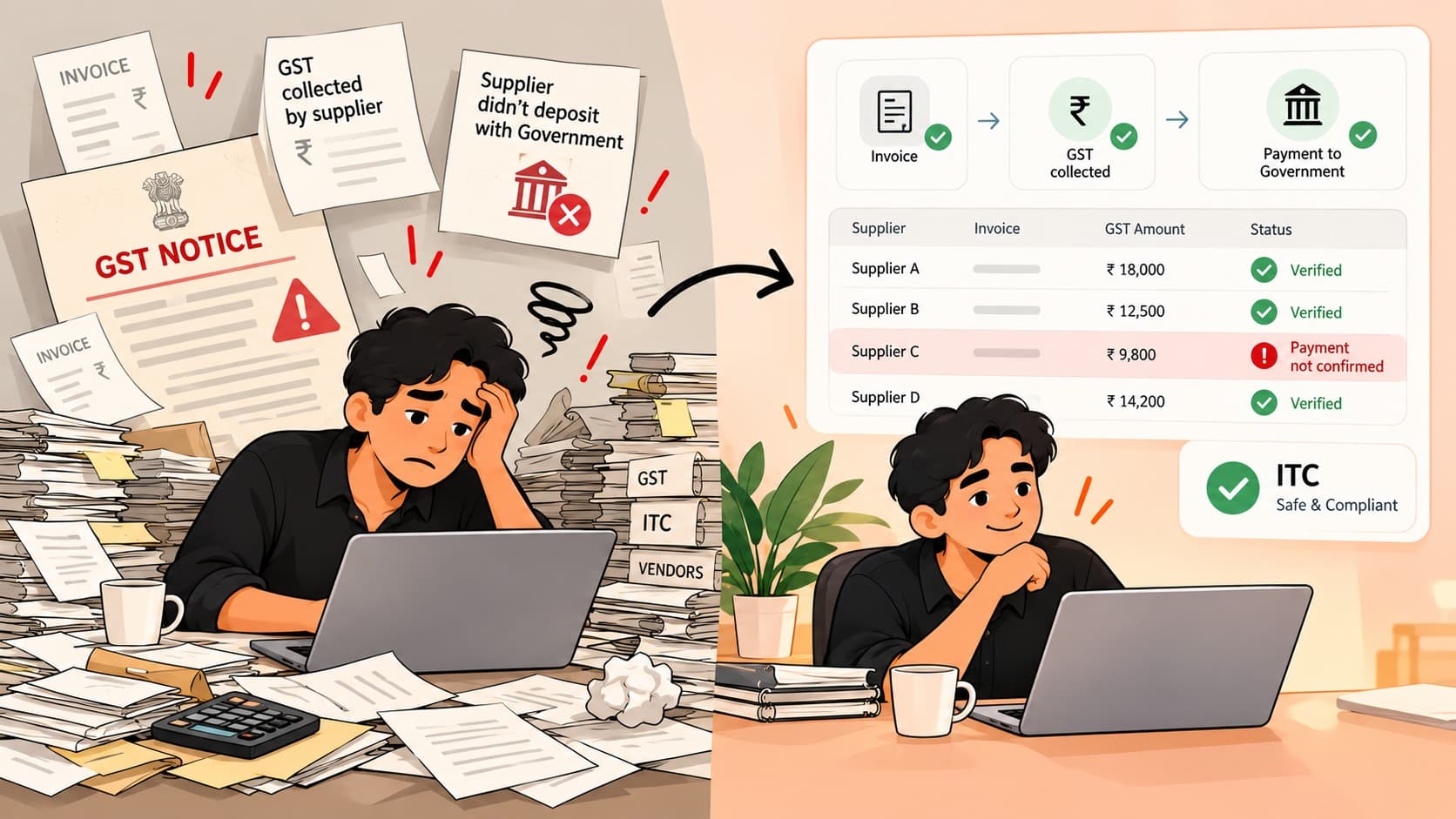
7. Reconciliation of GST-related records Businesses registered under GST must ensure that their accounting records and GST records are consistent and harmonized. The monthly activities may vary depending on the business and its filing arrangements. This may consist of the following:
Verification of output GST
Verification of input tax credit
Reconciliation of relevant purchase data
Verification of invoices
Verification of credit/debit notes
Identification of discrepancies
Preparation of information required for GST filing One of the key things to know is that GST compliance needs to be based on sound underlying books and not treated as an isolated exercise.
8. Monitoring Tax Deductions at Source (TDS) Companies obliged to make TDS deductions require an effective process that includes:
Identifying eligible transactions
Calculating deductions
Recording the TDS payables
Making the deposits
Keeping the records
Issuing the required reports According to the Income Tax authority, TDS applies to various payments, including salaries, interest, commissions, fees for professional services, or royalties, where applicable. Starting from April 1st, 2026, the Taxation Act 2025 comes into operation with changes to the sections quoted in the report. This implies the necessity for firms as well as accounting departments to update their approaches rather than depending on outdated methodologies.
9. Payroll-Related Accounting Process Payroll refers to yet another repetitive financial process that occurs in organizations with employees. Monthly accounting may require recording:
Employee gross pay
Deductions from the employee
Employer contributions
Wages payable
Payroll taxes
Reimbursements
Any bonuses or incentives as applicable Notes on the payroll process should enable consistency with general accounting practices.
10. Monitor Fixed Assets When businesses acquire equipment, computers, furniture, machinery or any other type of fixed asset, they should keep accurate fixed asset records. During month-end accounting, it may be necessary to keep records of the following:
New purchases of fixed assets
Disposal of fixed assets
Depreciation
Asset balance
Capital expenditures These records become crucial for companies that are engaging in major investments in their assets and infrastructure.
11. Create Monthly Profit and Loss Report A monthly profit and Loss report answers probably one of the most important questions in the business world: Did we earn money this month? However, the question is deeper. A company should go through such parameters as:
Sales
Cost of production
Gross profit
Operations expenditures
Finance charges
Profit before taxes
Net profit What is more important, even the figures by themselves are not enough; it is essential to follow trends/facts from the previous months/budgets/forecasts.
12. Analyze the Balance Sheet The balance sheet presents a different perspective of the company. It depicts:
Assets
Liabilities
Equity It is possible for a firm to report a profit according to its financial statement while it has substantial accounts receivable, debts, or other liabilities. That is the reason why reviewing only the P&L statement is not sufficient. The balance sheet gives management a broader understanding of the financial state of the organization.
13. Cash Flow Management Monitoring cash flow should be a priority for every business monthly. The following components must be checked:
Cash inflows (Receivables, Loans received, Profits from investment, Other cash inflows)
Cash outflows (Salaries paid, Payments made to vendors, Payments of rent, Working taxes, Loan repayments, Operating expenses, Expenses incurred for investments) By reviewing cash flow on a monthly basis, it is easier to anticipate cash shortages in time.
14. Generate Management Reports At this point, accounting goes beyond simple bookkeeping. Management information systems or MIS make it possible to transform accounting figures into information usable for managers. Depending on the specifics of the company, these reports may include:
Revenue trends
Gross margin
Net profit
Expenses
Aging receivables
Aging payables
Liquid assets
Budget vs actual results
Performance of departments or projects
Key ratios
Management reports should be tailored to the business decisions to be made. A SaaS founder might be interested in recurring revenue, customer acquisition costs, and profit margin. A retailer might be interested in inventory, sales velocity, and gross margin. A legal firm might care about utilization rate, profitability of projects and receivables. Good accounting reports start from the business issue and not the spreadsheet.
Comparison Between Monthly Accounting and Year-End Accounting: How are They Different?
The most obvious difference would be timing.
Monthly accounting Concentrates on maintaining the information up to date and frequently assessing the business.
Year-end accounting Concentrates on wrapping up the financial year, completing accounts, fulfilling tax needs, going through audits, and filing required reports.
One major shortcoming of using year-end accounting is that it restricts financial information to its historical record. Conversely, monthly accounting performs the function of a management tool.
What To Anticipate With Monthly Accounting Services For Small Enterprises?
Small-scale enterprises normally do not require a complicated finance function. They require one that is dependable. A good monthly accounting service should ideally ensure a regular monthly process.
You ought to know:
What documents are to be delivered
When they are to be delivered
Which work is to be done
When the reports are to be given to you
Accurate books: There should be no unresolved transactions for months. Reconciliations: Banking, payment and tax records should be properly reviewed. Accounting reports: In many cases, businesses need regular P&L and balance sheet reports, with other reports being based on the actual needs of their business. Visibility: Business owners should not wait for tax time to know their financial position. Professional review: Automation may be used to speed up accounting, but the human factor is still important. Data for 2026 shows that small businesses are evidently utilising AI and digital tools more extensively.
Accounting Services Outsourcing: Under What Conditions Does Your Company Require It?
Setting up and administering in-house finance services is not the sole option in accounting services. The growing demands of businesses can result in the increased complexity of accounting services that involve large volumes of transactions, taxes, timely reporting, and decision-making based on financial information.
In the case of Accounting Services Outsourcing, a business will have an opportunity to collaborate with professional accountants externally for various, periodic, or specialized financial processes according to the needs of the organization.
Outsourcing is especially helpful when:
The number of financial transactions increases
Financial accounting tasks occupy much time of management
Bookkeeping and financial reporting are done untimely
Additional expertise and resources are required by the finance department
Tax and compliance demands increase
Management requires timely financial reports
Improved cash flow and working capital need to be obtained
Financial information is needed by investors, creditors, or other stakeholders
The company is entering new markets
The finance department diverts attention from core activities
The scaling of the accounting department is required by the business
Outsourcing does not always involve a substitution for the in-house accounting department. In a majority of cases, outsourcing accounting is done in addition to the in-house department in order to provide more capacity, skills, technology or assistance.
There are many considerations that determine whether one should outsource or do the accounting in-house. Among other things, such factors include transaction nature and volume, complexity of the firm, in-house skills, technology availability, cost considerations and reporting needs. The issue is not about deciding which approach, outsourcing or in-house accounting, is superior. The issue is: What financial functions does your firm require and how can you best perform them?
How Technology Will Affect Monthly Accounting in 2026
Accounting in 2026 is markedly different from the spreadsheet-driven methodologies that many companies previously relied upon. The use of cloud platforms for accounting, automated banking systems, digitised invoicing and AI-powered workflows is allowing for less needless work to be done.
Recent research conducted in 2026 amongst small businesses shows that 80% of companies surveyed employ AI on a daily basis, while 53% of companies are still using spreadsheets to manage their finances. This shows something important. While companies are adopting technology, they still have unconnected and disjointed workflows related to finance. As such, integration is becoming just as essential as automation.
Modern financial workflows can now integrate:
Banking
Accounting software
Payroll
Invoices
Payment methods
CRM systems
E-commerce solutions
Expense control
Tax and compliance workflows
In this case, the aim is not to simply pile on as many finance-related programs as possible. The idea is to create an uninterrupted flow of finance-related information. AI can handle repetitive tasks such as data input, tax classification and reporting. However, not all processes should be automated right away.
A Practical Monthly Accounting Calendar
Businesses should be aware of four main stages of their monthly accounting cycle.
1st week: Collection Gather these documents:
sales invoices
purchase invoices
receipts
bank statements
statements from payment gateways
payroll data
loan statements
other documents
2nd week: Record Complete the following steps:
transactional posting
bank reconciliations
expense classification
receivables and payables
GST and TDS reconciliation
3rd week: Closing Prepare the following documents:
trial balance
profit and loss
cash flow statements
receivables
payables
4th week: Review Management needs to check:
Revenue
Profitability
Expenses
Cash
Outstanding collections and payments
Budget vs actuals Many people miss this last stage; however, accounting is useful only if its numbers lead to action.
Here are 10 important questions to consider while selecting a monthly bookkeeping provider:
First, what is included in the service?
Will bank reconciliations be done monthly?
Will the accountant handle GST and TDS accounts?
What financial documents will you receive?
How long will it take for your accounts to be balanced?
Who checks the accountant's work?
What accounting programs will be used?
Is the bookkeeping service capable of growing along with your business?
Finally, the lowest price for the monthly bookkeeping isn't always the best price.
What is the Monthly Accounting Services Cost?
There isn't a fixed amount for monthly accounting costs. Pricing can vary depending on:
How many transactions there are each month
The business type
How many bank accounts there are
GST demands
Payroll complexity
How many entities there are
Inventory requirements
Accounting software
Reporting demands
Professional review level
Inclusion of tax filing
The current models of accounting services in India work on the basis of either transaction volumes or the scope of work done instead of having unified pricing across vendors. Businesses are, therefore, recommended to compare the extent of services instead of just monthly charges when evaluating service providers.
What Constitutes a Monthly Bookkeeping Checklist That Meets the Expectations of the Clients?
For business owners, a useful checklist that can be followed monthly appears in the list below:
Transactions
Sales
Purchases
Expenses
Credit or debit notes
Other incomes
Reconciliation
Bank account reconciliation
Credit card reconciliation
Payment gateway reconciliation
Customer balance verification
Vendor balance verification
Compliance
Checking GST records
Calculating the input tax credit
Checking TDS transactions
Reviewing tax liabilities
Tracking payments/filings
Financial reporting
Trial balance checking
P&L Preparation
Balance sheet checking
Cash position checking
Receivable ageing checking
Payable ageing checking
Management review
Revenue in comparison to the previous month
Expense checking
Margins checking
Budget vs. actuals review
Cash requirement evaluation
Identifying action items

Find your gap before month-end
We'll reconcile one month of settlements against your orders. No commitment.
Conclusion: Monthly Accounting Should Not Only Provide You With Good Books
Monthly accounting is often seen as a mere administrative task. But it has to be more than that. Through your books, you should be able to answer the questions:
How much did we earn?
How much did we spend?
How much do we have to receive from customers?
How much do we have to pay?
How much financial resources do we have?
Are we really making a profit?
What changed in our accounts this month?
And most importantly, what should we do?
The real benefits of Monthly Accounting Services come from the fact that, for small businesses, keeping up with accounts on a monthly basis allows us to achieve financial transparency, relieve the burden of year-end accounting and make better decisions. As accounting is set to become even more solidly automated and interconnected by the year 2026, we can say that the function of accounting moves beyond mere recording of transactions and the companies that gain most from their financial functions will be the ones that integrate accounting information with technological tools and professional guidance.
Frequently Asked Questions
1. What does Monthly Accounting Services mean?
Monthly Accounting Services basically covers all accounting tasks that need to be done on a monthly basis to keep the accounts of the business accurate. The monthly accounting process may include bookkeeping, bank posting, accounts receivable and accounts payable tracking, income tax preparation, and financial reporting.
2. What does an accounting service perform in a month?
Some of the general accounting tasks that are carried out in a month may include recording sales and expenditures, reconciling bank accounts, working on receivables and payables, calculating income tax, payroll preparation, and financial accountability.
3. Would Monthly Accounting Services be beneficial for smaller businesses?
Yes, we could say that small-sized businesses can benefit from this type of accounting service because it provides lots of relevant information with respect to revenue and expenses, receivables and payables, as well as profit, before the year-end.
4. What is included in Monthly Bookkeeping Services?
Monthly Bookkeeping Services usually entail sales expense recording, ledger management, bank statement reconciliations, and accounts receivable & payable tracking.
5. What financial statements am I supposed to get every month?
Most companies need to have monthly profit-and-loss reports, balance sheets, cash flow statements, and accounts receivable and accounts payable ageing reports. Start-up businesses also need to check the budget vs. actual budget reports, profitability evaluation reports, as well as other reports the management needs.
About Lighthaus: Lighthaus is a modern accounting firm, built for the AI era. We aim to take your bookkeeping one step further. Instead of closing books monthly, we aim to close them on a daily basis.

Bringing financial clarity to business owners is Samhith's life goal after graduating from IIT & ISB.
Get in touch
We get back to you within 24 hours