Accounting Solutions for 100cr+ Enterprises: The Comprehensive Guide
What is included in accounting services for businesses that are expanding? Find out about bookkeeping, GST, reconciliations, payroll, and more.


In this Article
Accounting Services for 100 Crore + Businesses: What Should Be Included?
If a business is small, accounting can appear simple.
You earn income.
You pay your vendors.
You account for expenses.
You do your taxes.
You reconcile accounts.
You send invoices.
Maybe you have an accountant doing your books at the end of every month.
But growth makes it all different.
More customers mean more accounting transactions. More employees mean more payroll. More vendors mean more invoices. Multiple sales channels require more reconciliation. And if you are selling through online marketplaces, using payment gateways, maintaining inventories across warehouses, or operating in multiple states, your accounting becomes more complicated.
At a certain point, “we have an accountant” doesn’t necessarily equal “we have financial visibility.”
An expanding business needs to know more than if their books are done. It needs to know how much money it makes, where it spends, which customers, products, or sales channels make it money, what it owes, what is owed to it, what taxes are due, and how much cash flow it has.
This is where professional accounting services come into play.
What Are The Accounting Services For a Growing Business?
Accounting services involve all the procedures associated with recording, structuring, reconciling, reporting, and analyzing the financial data of a business organization.
According to the type of business, these services may include:
Bookkeeping
Bank reconciliation
Accounts payable
Accounts receivable
Invoicing and revenue accounting
GST accounting and compliance
TDS accounting and reconciliation
Payroll accounting
Expense management
Financial statements
Cash flow reporting
Inventory accounting
Marketplace reconciliation
Multi-system reconciliation
Management reporting
Financial analysis
Budgeting and forecasting
Not every business needs all of these services. A consulting firm with a small workforce will have fairly simple accounting needs.
An e-commerce business that sells its products through its website, Amazon, Flipkart, and quick commerce websites will have a complicated accounting landscape.
A B2B business will have few customers but significantly larger invoices, credit periods, and longer receivable cycles.
And a business that operates in multiple states will have multiple GST registrations, warehouses, stock transfers, and accounting requirements by state.
Thus, the right accounting department is contingent upon the nature of the business, not only its size.
Accounting vs Bookkeeping: What's the difference?
This is a crucial concept to know.
Bookkeeping
Bookkeeping is more to do with documentation of financial transactions.
Examples include:
Recording sales
Recording purchases
Recording expenses
Recording invoices
Recording payments
Categorizing transactions Ledger management
Bank statement reconciliation
The fundamental question answered by bookkeeping is: “What is going on financially?”
Accounting
Accounting builds upon the information recorded. It entails organizing, analyzing and reporting financial information to help managers make sense of the information and what to do next.
It may involve:
Financial statements
Profitability analysis
Cash flow analysis
Tax accounting
Financial reporting
Budgeting
Forecasting
Managerial reporting
The larger question answered by accounting is: “What does this information mean and what action should be taken?”
Both bookkeeping and accounting are essential. Proper accounting relies on proper records.
Accounting Services that a 100 Crore+ Business Should Have
There is no accounting software suite that fits all businesses. Nevertheless, a good accounting function will usually include the following services.
1. Bookkeeping and Proper Recording of Transactions
Bookkeeping is the basis of the accounting process.
Any business requires a mechanism that will allow proper:
Recording of sales
Recording of purchases
Recording of expenses
Recording of vendor payments
Recording of customer payments
Recording of banking transactions
Recording of loans
Recording of assets
Recording of liabilities
Recording of tax transactions
Proper recording of transactions allows generating financial statements based on accurate figures.
Poor bookkeeping leads to further difficulties in the accounting process.
Improper recording of an expense will misstate the profitability of the business. Wrong linking of customer payments to particular invoices will create problems with accounts receivable.
Incorrect reconciliation of marketplace transactions will lead to discrepancies between revenue and money received from clients.
This is why bookkeeping is more than entering data.
2. Bank Reconciliation
In reconciling the bank statement, one compares transactions that are done in the accounting system to those done in the bank statement.
It can help us find out about:
Transactions missed in recording
Duplicated entries
Bank charges
Wrong entries
Unrecorded transactions
Unreconciled transactions
Time differences
For a business that uses one bank account and has few transactions, the reconciliation process will be easy. However, as the business grows and uses more than one bank account, many other payment methods and more transactions, the process will be critical.
It is important for the accounting system to find out why the two balances are different.
3. Accounts Payable
Accounts payable is any money owed by a business to its suppliers and vendors.
Accounting assistance may include the following:
Vendor invoices
Outstanding invoices
Pay schedules
Vendor balances
Pre-payments
Credit notes
Payment history
Vendor reconciliations
This increases the awareness of the business about future liabilities.
It also prevents cases where the business seems to be doing well but faces cash flow problems due to payments from several vendors falling in the same period.
4. Accounts Receivable
Accounts receivable represents money owed by the customers to the business.
It is essential for a well-organised accounting system to give insight into the following:
Billing of customers
Money received
Balance outstanding
Overdue accounts
Credit notes
Advance payments by customers
Ageing of receivables
This is especially relevant for businesses dealing with sales on credit terms. It could happen that a business may make a profit but suffer from cash flow problems due to delayed payments by customers.
That is because: Profit does not mean cash flow.
5. Accounting for B2B Enterprises
There are different challenges involved in B2B accounting. Whereas there could be fewer customers for a B2B business compared to a D2C enterprise, each one could contribute more revenue-wise.
There could also be:
Negotiated payment terms
Purchase orders
Longer payment cycles
Custom pricing
Advanced payments
Credit notes
Debit notes
Milestone-based invoicing
Outstanding payments
This implies that accounts receivable become critical here.
Among others, B2B accounting should assist in finding out:
What was our income per client?
How much do we owe in receivables?
What are the overdue invoices?
What is the average payment cycle?
How much do we expect from our clients?
Who owes us the biggest outstanding balance?
What are the profits made from the major client?
It is not only a matter of asking: “How much did we sell?”
It is also about asking: “How much have we collected, how much do we owe, and when do we expect the rest?”
For B2B enterprises, the accounting process must tie together revenue, receivables, collections, profitability, and cash flow.
6. Invoicing and Revenue Accounting
There should be a process for creating and documenting invoices for businesses.
Supporting the accounting process involves:
Invoicing
Sales
Accounts of the customers
Credit notes
Debit notes
Revenue accounting
Linking payments to the respective sales
Revenue accounting is made difficult by the presence of several platforms used by the business to conduct its operations.
This means that the customer orders something on one platform but pays via another, and the company ends up receiving the net amount.
7. GST Accounting & Compliance
For GST-registered entities, it is essential that accounting facilitates proper reporting of GST.
This includes:
Classification of GST
Output GST accounting
Input tax credit
Purchase reconciliation
Sales reconciliation
Reporting of GSTR
GST reconciliation
Accounting for credit notes
Multi-state GST accounting
GST is not just about filing returns on a month-to-month basis. Your accounting, invoices, purchases, settlements, and GST must talk to each other.
8. Multi-State GST: Why Does Accounting Become More Complex?
Operating across multiple states can also become another challenge of accounting and reconciliation.
A company will need to deal with:
Multiple GST registrations
Multiple GSTINs
State-wise accounting
Inter- and intra-state transactions
Stocks in various states
Stock movement
ITC between registrations
GST reporting on a state basis
Marketplace FBO
Reconciliation across GST registrations
For e-commerce businesses, there is even more complexity involved where there is stock stored in FBO across different states. This means that accounting cannot look at every single GST registration in isolation.
It needs to stay connected to the transactions, stocks, invoices, settlements and tax records. For companies that operate across multiple GST registrations, Lighthaus helps with state-wise accounting, GSTIN transfer, ITC and GST filing across registrations.
Multi-state GST, hence, becomes not only a compliance challenge but also an accounting and reconciliation challenge.
9. Accounting and Reconciliation for TDS
TDS could add another level of complexity to accounting.
For instance:
Invoice Amount: ₹1,00,000
TDS deduction: ₹10,000
Bank Deposit: ₹90,000
The accounting entry should still take into account the total transaction amount and not just ₹90,000 as the invoice amount.
Accounting assistance may involve managing:
TDS Deductions
TDS Receivables
TDS Certificates
Information about Form 26AS
TDS Reconciliation
Discrepancies between the accounts and tax records
This becomes crucial especially when there are many clients and high TDS deductions.
10. Payroll Accounting
Payroll is yet another accounting activity that will arise when the team expands.
Payroll accounting consists of the following:
Salary ledger
Payroll journals
Employee reimbursement
Statutory deduction
Payroll liabilities
Salary payments
Payroll reconciliation
The small team might do well with an informal process. But payroll accounting will become more systematic as employee numbers grow.
11. Expense Control
There are various types of expenses that businesses have, which may become hard to monitor.
These can include:
Travel expenses
Subscriptions to software packages
Advertising costs
Stationery
Consulting fees
Freight charges
Maintenance expenses
Reimbursement of employees
The accounting system must ensure proper recording and classification of expenses.
The purpose of this process is not just to determine how much the business has spent.
The purpose must also be to know the following: Where is the business spending its money?
12. Financial Statements
Financial statements provide management with a structured overview of the performance and financial situation of the business.
Three main financial statements are:
Statement of Profit and Loss
Revenue - Expenses = Profit/Loss
The profit and loss statement enables us to assess business performance for a certain period of time.
Balance Sheet
The balance sheet contains:
Assets
Liabilities
Equity
Statement of Cash Flows
The cash flows statement describes the inflow and outflow of cash in the business.
It is important to understand this point because:
Profit and cash are different things.
A business can have a profit but little cash at its disposal. It is vital for a growing business to know all three statements.
13. Monthly Financial Reporting
Accounting should not be restricted only to tax compliance.
A growing firm requires financial information on a regular basis.
Items included in monthly report may include:
Sales
Gross profit
Operating expenses
Net profit
Cash balance
Accounts receivable
Accounts payable
Inventory
Ratios
But the monthly report should not merely be a tabulation of data.
A monthly report should help management to determine:
What has happened?
Why has it happened?
Is the change a good thing or a bad one?
Where should management concentrate next?
This is where accounting transcends its role as a compliance function to become a decision-making function.
14. Cash Flow Management
Cash flow will determine how easily a company navigates its next phase of growth.
The accounting system must give insight into:
Available cash
Collections from customers
Payments to suppliers
Payroll obligations
Taxes
Loans
Inventory
Future expenses
The purpose is to recognise potential problems related to cash flow before there are any.
A company should not find out that it doesn’t have enough cash just when the bill comes due.
15. Inventory Accounting
In product-driven companies, inventory may prove to be one of the most crucial factors from a financial point of view.
Examples of inventory accounting may include:
Purchases
Stock valuation
Cost of goods sold
Inventory corrections
Damaged inventories
Returns
Inventories in warehouse
Closing inventories
In the case of D2C, inventories may be located in:
Owned warehouses
3PL partners
Amazon fulfilment centres
Flipkart fulfilment centres
Quick commerce warehouses
Retail distributors
The ideal case scenario is that inventory movement is synchronized with accounting.
16. Accounting of D2C Brands
Accounting gets complicated in D2C because it is possible that a brand uses multiple selling channels at the same time.
Example:
Website + Amazon + Flipkart + Quick Commerce + Offline Retail = One Business
However, each channel will have its own:
Commission structure
Settlements
Returns/Refunds
Discounts
Shipping charges
Advertising cost
Penalty
TDS/TCS
Thus, D2C brands require accounting of not just the total revenue figure but also:
Revenue per channel
Margin per SKU
Profitability per channel
Marketplace fees
Returns/refunds
Marketing cost
Inventory position
Difference in settlements
Cash flow
It is very much possible that a product becomes a bestseller but unprofitable.
In the same way, it is possible that a particular channel earns a lot of money but makes the contribution margin lower. Thus, D2C accounting requires accounting of Sales, Settlements, Inventory, and Profitability together.
17. Marketplace and Settlement Reconciliation
This is especially relevant for D2C and e-commerce enterprises.
Suppose your enterprise has gross sales of ₹10 lakh through a marketplace.
You would think ₹10 lakh will get credited into your bank account.
However, settlement might have deductions such as:
Marketplace fee
Freight charges
Returns
Refunds
Deductions
Ad costs
TDS
TCS
Other adjustments
That is, Gross sales income ≠ Marketplace settlement.
A good accounting system needs to reconcile marketplace settlements against orders and bank credits. At Lighthaus, marketplace settlement reconciliation is one of the core components of our accounting process that covers Amazon, Flipkart and quick-commerce payments.
In the case of high-volume businesses, doing this manually becomes tough.
18. Reconciliation Involving Multiple Financial Systems
Most modern organizations don’t conduct their businesses using a single financial system.
Based on the organization, the ecosystem can consist of:
Shopify
Amazon
Flipkart
Razorpay
Unicommerce
Tally
Zoho
Banking systems
Payroll systems
Inventory systems
The issue is not just gathering data from all these systems.
The issue is ensuring that the data aligns.
A good accounting system would ensure reconciliation of:
Sales ↔ Settlements ↔ Charges ↔ Banking ↔ Accounts
And where applicable:
Purchase ↔ Supplier Billing ↔ GST Data ↔ Payments ↔ Accounts
19. Financial Analysis and Business Understanding
Here, accounting can go beyond just reporting.
The accountant might say to you: “Income increased by 25%.”
Better accounting will help you find out:
What products led to the increase?
What channel contributed to the increase?
Was there any improvement in the gross margin?
Have marketing expenses increased more rapidly than income?
Are the returns increasing?
Is the marketplace commission eating into your margins?
What products aren’t making money?
How much money are you tying up in inventories?
This is particularly useful for D2C companies, where looking at margins per SKU and per channel, not just one overall P&L number, gives you a much better perspective.
What Are Outsourced Accounting Services?
Outsourcing accounting services means outsourcing some or all accounting processes of a company to an external accounting service provider.
Rather than setting up a complete accounting department within a business organization, it may outsource the following activities:
Bookkeeping
Reconciliation
Accounts Payable
Accounts Receivable
GST Services
TDS Reconciliation
Payroll Accounting
Financial Reporting
Marketplace Reconciliation
Management Reporting
Customization is possible depending on requirements. It is unlike appointing an external accountant to file your taxes annually. The contemporary outsourced accounting service model can be like an extension of the accounting department within your company.
Why Do 100 Crore+ Businesses Outsource Their Accounting?
There is no simple reason why any particular business chooses to outsource accounting.
For growing businesses, it comes down to leveraging the right combination of expertise, process, technology and financial insight without the need to develop capabilities within the business.
1. Access to More Finance Capabilities
A growing business will typically have a range of accounting needs, including bookkeeping, GST, reconciliation, payroll, reporting, accounts receivable, accounts payable and analysis. An outsourced accounting partner provides the ability to access multiple areas of expertise rather than having to rely on one person who does everything.
2. Specialist Knowledge
Each business will have different accounting needs depending on its business model.
An e-commerce business may require marketplace and settlement reconciliation.
A software business may require accounting for subscription revenues.
A manufacturing business may require inventory and cost accounting.
The accountant should have an understanding of the financial model of the business that it serves.
3. More Time for Business Owners and Managers
In the course of business growth, the owners and management may get stuck doing:
Accounting for transactions
Invoicing of clients
Collection of accounts receivable
Review of spreadsheets
Preparation of documents for tax purposes
It is possible that through outsourcing, some of these routine accounting functions can be transferred.
4. Improved Financial Visibility
Outsourcing is not just a transfer of the accounting function.
Rather, outsourcing should aim at:
Improved accounting → improved reporting → improved visibility → better decision-making.
When Does a 100 Crore+ Need to Outsource Their Accounting?
There is no specific figure that a company reaches at which the need for outsourcing accounting emerges. On the contrary, consider the complexity of your business and whether the existing accounting process is sufficient.
1. Accounting falls behind
If you get last month's report several weeks after it ends, you might have outdated financial information.
At Lighthaus, we work on delivering the latest financial positions through nightly book closure.
2. Everything is managed manually by the founder or bookkeeper
It can mean that the accounting process has become too personal.
3. You have several ways to sell your products
Each of these ways increases settlements, fees, returns and reconciliations.
4. You don't understand profitability
Having knowledge about income doesn't mean that you understand the profitability of products, customers or sales channels.
5. GST became complicated
Several states, GST registrations, warehouses and marketplaces can make your accounting more complicated.
6. Reporting is always outdated
If your accounting process is always in "cleanup" mode, your business may require a solution that will provide timely financial data rather than another spreadsheet.
Comparison between Traditional Accounting and Contemporary Outsourced Accounting
A traditional accounting system is usually structured as follows:
Transactions → Accountant → Month-end accounts → Profit & Loss Statement → Business owner
Information comes when the period is over.
A contemporary accounting system should provide:
Business tools → Automation of information collection → Reconciliation → Accountant’s assessment → Up-to-date information
It is not only about technology. It is all about timing.
If you get information about the company's performance several weeks after the decision-making, even if this information is absolutely correct, it will be useless.
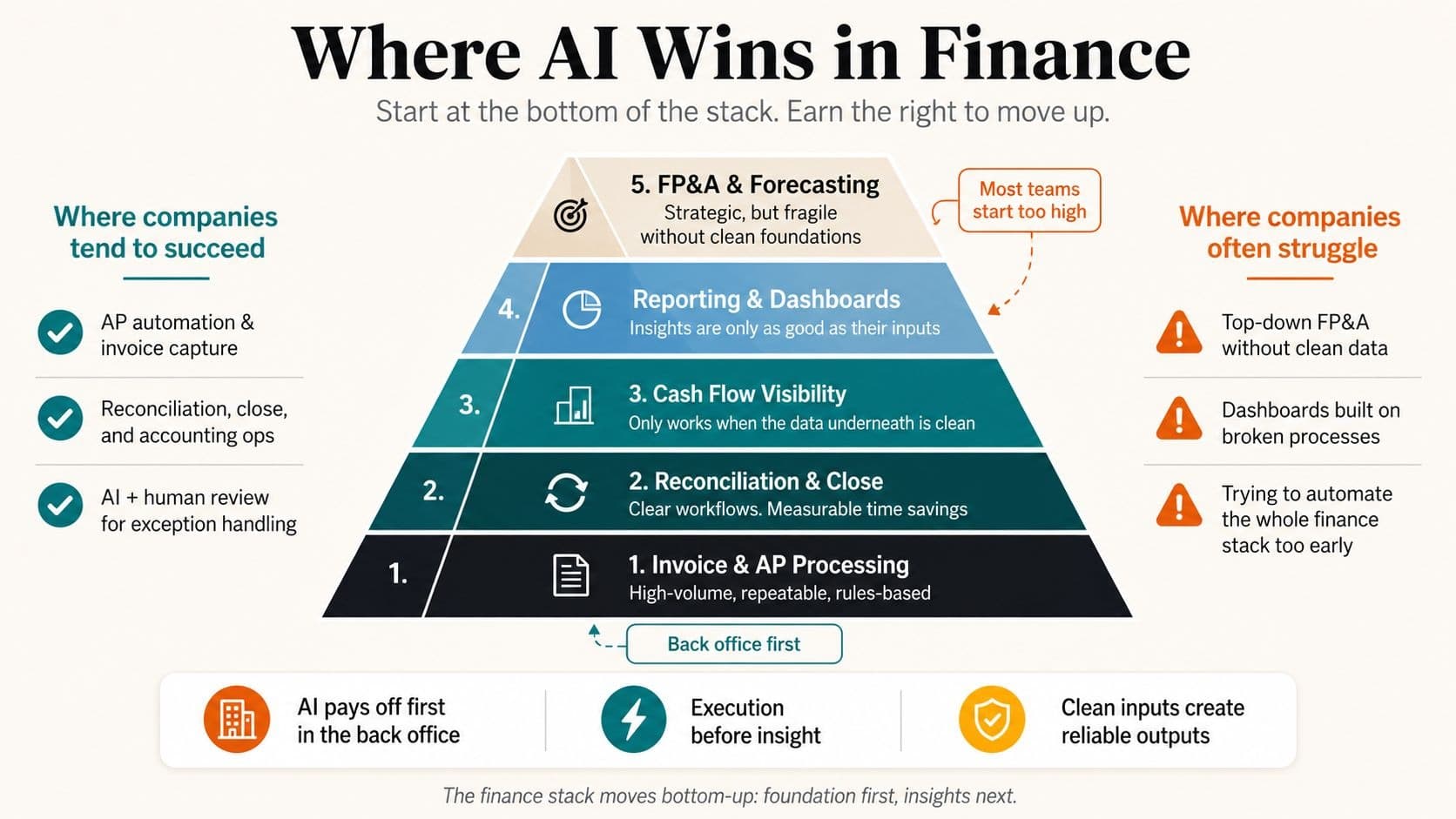
Lighthaus defines their accounting system as one that connects business tools and sales channels, with artificial intelligence doing routine accounting tasks, with accountants’ review afterwards.
Can AI replace accountants?
It’s become an issue that more and more small companies are facing when they consider using AI in their accounting processes. And the real question is: What areas of accounting can be automated through the use of AI, and what cannot?
The areas where AI can help include the following:
Data extraction
Transaction classification
Transactions matching
Reconciliation
Anomaly detection
Reporting
Pattern recognition
However, accounting requires judgement.
Somebody needs to investigate transactions that don’t look typical.
Somebody needs to evaluate exceptions.
Somebody needs to have the context of the business.
Somebody needs to ensure that the data makes sense.
This is what Lighthaus does - their AI takes care of repetitive tasks in accounting, whereas their accountants analyze the results.
It’s more realistic than trying to teach software to comprehend every financial situation on its own.
Criteria for Choosing Professional Accounting Services
Accounting services go beyond cost comparison.
Here’s what to ask.
Do they understand your business?
The way accounts are handled for a D2C brand differs from that of a consulting business.
Knowledge of industry and business models is important. What does the service include?
Here's a list of areas to cover with the provider:
Bookkeeping
Reconciliation
GST
TDS
Payroll
Accounts Payable
Accounts Receivable
Financial Statements
Cash Flow
Inventory
Marketplace Settlements
Management Reporting
Don't take anything for granted. Clarify the scope of services.
How often do the books close? Is it monthly? Weekly? Daily?
If you have many transactions, more frequent closure may be helpful.
Whose work will be reviewed?
Automation allows you to process transactions. However, human review is necessary.
Whose responsibility is it to investigate exceptions and approve the books?
Can the service integrate with existing tools?
Integration is increasingly critical when you use many systems within your business.
Will you get insights along with reports? The report shows what happened. You need not only that but also an understanding of the reason why it happened.
How Expensive Are Accounting Services?
Accounting services don't have a set price.
The price depends on:
Number of transactions
Number of bank accounts
Number of employees
Number of GST accounts
Number of sales channels
Complexity of inventory management
Activity in marketplaces
Report requirements
Extent of outsourcing
Financial analysis requirements
But the more pressing question is not just: “How expensive is accounting?”
It's also: “What is the cost to your business of bad accounting?”
Which can be:
Missed tax write-offs
Leakage of revenue
Margin mistakes
Unexpected cash flow issues
Bad business decisions
Non-compliance
Management time wasted solving accounting problems
Cheap accounting doesn't necessarily mean cheap accounting.
Typical Mistakes That Companies Make in Accounting
1. Viewing Accounting as End-of-Year Work
Accounting is supposed to facilitate decision-making throughout the entire period.
2. Concentrating on Revenue Only
An increase in revenue does not imply profit growth.
3. Neglecting Cash Flow
Profitability and cash position are two separate concepts.
4. Failing to Reconcile Market Payments
The gross sales figure may differ significantly from the net settlement.
5. Applying Only Consolidated P&L
Consolidated P&L might obscure the differences between different products or sales channels.
6. Dependent Only on Spreadsheets
Spreadsheets work great at lower volumes but will become problematic with increasing transaction volume.
7. Hiring an Accountant Only by Its Cost
An accounting error might cost much more than the fee itself.
8. Failing to Ask for On-Time Books
Timely information might be equally useless commercially.
The Future of Small Business Accounting
Small business accounting is transitioning from an otherwise manual and periodic process to a more integrated process powered by technology.
Where:
Data collection → Spreadsheet updates → Reconciliation → Report preparation
Businesses can transition towards:
Systems integration → Automation of repetitive tasks → Continuous reconciliation → Exceptions analysis → QuickBooks closing → Performance analysis
Technology isn't all there is to the process.
The real value lies in the combination of:
Automation + Accounting skillset + Financial data on time.
According to Lighthaus, this combination involves integration of tools, sales and payment systems, automation of repetitive tasks through AI and accountants backing up the process.
This kind of business model works well for companies whose level of financial complexity exceeds that of their internal finance teams.
Conclusion
As the business becomes more complex, the need for accounting becomes more critical.
For B2B business, that could be more visibility into receivables, collection cycles, profitability by customers and cash flow.
For D2C business, that could be linking the marketplace settlement, inventory, SKU margins, returns and channel profitability. For multi-state businesses, it could be managing the GST registration, state-level accounting, movement of inventory, ITC and reconciliations.
And for all growing businesses in general, it could be moving beyond just asking: Are the books up to date?
The right questions to ask would be:
How profitable are we?
Where is the cash?
Who owes us?
What do we owe?
Which products/customers/channels are profitable?
Are GST and tax records matching our books?
Does management have the necessary information on time?
And that is where accounting shifts from compliance to business function.
Accurate books. Timely information. Better decision-making.
FAQs
1. What are accounting services for an emerging business?
Some accounting services can include bookkeeping, bank reconciliation, accounts payables/receivables, GST, TDS, payroll, financial statements, cash flow, inventory, marketplace reconciliation, and financial analysis. It will be dependent upon the type of business and its level of complexity.
2. Are bookkeeping and accounting the same?
Not necessarily. While bookkeeping deals with capturing and categorization of financial transactions, accounting is the process of analyzing, interpreting, and reporting the information.Accounting Services for 100 Crore + Businesses: What Should Be Included?
If a business is small, accounting can appear simple.
You earn income.
You pay your vendors.
You account for expenses.
You do your taxes.
You reconcile accounts.
You send invoices.
Maybe you have an accountant doing your books at the end of every month.
But growth makes it all different.
More customers mean more accounting transactions. More employees mean more payroll. More vendors mean more invoices. Multiple sales channels require more reconciliation. And if you are selling through online marketplaces, using payment gateways, maintaining inventories across warehouses, or operating in multiple states, your accounting becomes more complicated.
At a certain point, “we have an accountant” doesn’t necessarily equal “we have financial visibility.”
An expanding business needs to know more than if their books are done. It needs to know how much money it makes, where it spends, which customers, products, or sales channels make it money, what it owes, what is owed to it, what taxes are due, and how much cash flow it has.
This is where professional accounting services come into play.
What Are The Accounting Services For a Growing Business?
Accounting services involve all the procedures associated with recording, structuring, reconciling, reporting, and analyzing the financial data of a business organization.
According to the type of business, these services may include:
Bookkeeping
Bank reconciliation
Accounts payable
Accounts receivable
Invoicing and revenue accounting
GST accounting and compliance
TDS accounting and reconciliation
Payroll accounting
Expense management
Financial statements
Cash flow reporting
Inventory accounting
Marketplace reconciliation
Multi-system reconciliation
Management reporting
Financial analysis
Budgeting and forecasting
Not every business needs all of these services. A consulting firm with a small workforce will have fairly simple accounting needs.
An e-commerce business that sells its products through its website, Amazon, Flipkart, and quick commerce websites will have a complicated accounting landscape.
A B2B business will have few customers but significantly larger invoices, credit periods, and longer receivable cycles.
And a business that operates in multiple states will have multiple GST registrations, warehouses, stock transfers, and accounting requirements by state.
Thus, the right accounting department is contingent upon the nature of the business, not only its size.
Accounting vs Bookkeeping: What's the difference?
This is a crucial concept to know.
Bookkeeping
Bookkeeping is more to do with documentation of financial transactions.
Examples include:
Recording sales
Recording purchases
Recording expenses
Recording invoices
Recording payments
Categorizing transactions Ledger management
Bank statement reconciliation
The fundamental question answered by bookkeeping is: “What is going on financially?”
Accounting
Accounting builds upon the information recorded. It entails organizing, analyzing and reporting financial information to help managers make sense of the information and what to do next.
It may involve:
Financial statements
Profitability analysis
Cash flow analysis
Tax accounting
Financial reporting
Budgeting
Forecasting
Managerial reporting
The larger question answered by accounting is: “What does this information mean and what action should be taken?”
Both bookkeeping and accounting are essential. Proper accounting relies on proper records.
Accounting Services that a 100 Crore+ Business Should Have
There is no accounting software suite that fits all businesses. Nevertheless, a good accounting function will usually include the following services.
1. Bookkeeping and Proper Recording of Transactions
Bookkeeping is the basis of the accounting process.
Any business requires a mechanism that will allow proper:
Recording of sales
Recording of purchases
Recording of expenses
Recording of vendor payments
Recording of customer payments
Recording of banking transactions
Recording of loans
Recording of assets
Recording of liabilities
Recording of tax transactions
Proper recording of transactions allows generating financial statements based on accurate figures.
Poor bookkeeping leads to further difficulties in the accounting process.
Improper recording of an expense will misstate the profitability of the business. Wrong linking of customer payments to particular invoices will create problems with accounts receivable.
Incorrect reconciliation of marketplace transactions will lead to discrepancies between revenue and money received from clients.
This is why bookkeeping is more than entering data.
2. Bank Reconciliation
In reconciling the bank statement, one compares transactions that are done in the accounting system to those done in the bank statement.
It can help us find out about:
Transactions missed in recording
Duplicated entries
Bank charges
Wrong entries
Unrecorded transactions
Unreconciled transactions
Time differences
For a business that uses one bank account and has few transactions, the reconciliation process will be easy. However, as the business grows and uses more than one bank account, many other payment methods and more transactions, the process will be critical.
It is important for the accounting system to find out why the two balances are different.
3. Accounts Payable
Accounts payable is any money owed by a business to its suppliers and vendors.
Accounting assistance may include the following:
Vendor invoices
Outstanding invoices
Pay schedules
Vendor balances
Pre-payments
Credit notes
Payment history
Vendor reconciliations
This increases the awareness of the business about future liabilities.
It also prevents cases where the business seems to be doing well but faces cash flow problems due to payments from several vendors falling in the same period.
4. Accounts Receivable
Accounts receivable represents money owed by the customers to the business.
It is essential for a well-organised accounting system to give insight into the following:
Billing of customers
Money received
Balance outstanding
Overdue accounts
Credit notes
Advance payments by customers
Ageing of receivables
This is especially relevant for businesses dealing with sales on credit terms. It could happen that a business may make a profit but suffer from cash flow problems due to delayed payments by customers.
That is because: Profit does not mean cash flow.
5. Accounting for B2B Enterprises
There are different challenges involved in B2B accounting. Whereas there could be fewer customers for a B2B business compared to a D2C enterprise, each one could contribute more revenue-wise.
There could also be:
Negotiated payment terms
Purchase orders
Longer payment cycles
Custom pricing
Advanced payments
Credit notes
Debit notes
Milestone-based invoicing
Outstanding payments
This implies that accounts receivable become critical here.
Among others, B2B accounting should assist in finding out:
What was our income per client?
How much do we owe in receivables?
What are the overdue invoices?
What is the average payment cycle?
How much do we expect from our clients?
Who owes us the biggest outstanding balance?
What are the profits made from the major client?
It is not only a matter of asking: “How much did we sell?”
It is also about asking: “How much have we collected, how much do we owe, and when do we expect the rest?”
For B2B enterprises, the accounting process must tie together revenue, receivables, collections, profitability, and cash flow.
6. Invoicing and Revenue Accounting
There should be a process for creating and documenting invoices for businesses.
Supporting the accounting process involves:
Invoicing
Sales
Accounts of the customers
Credit notes
Debit notes
Revenue accounting
Linking payments to the respective sales
Revenue accounting is made difficult by the presence of several platforms used by the business to conduct its operations.
This means that the customer orders something on one platform but pays via another, and the company ends up receiving the net amount.
7. GST Accounting & Compliance
For GST-registered entities, it is essential that accounting facilitates proper reporting of GST.
This includes:
Classification of GST
Output GST accounting
Input tax credit
Purchase reconciliation
Sales reconciliation
Reporting of GSTR
GST reconciliation
Accounting for credit notes
Multi-state GST accounting
GST is not just about filing returns on a month-to-month basis. Your accounting, invoices, purchases, settlements, and GST must talk to each other.
8. Multi-State GST: Why Does Accounting Become More Complex?
Operating across multiple states can also become another challenge of accounting and reconciliation.
A company will need to deal with:
Multiple GST registrations
Multiple GSTINs
State-wise accounting
Inter- and intra-state transactions
Stocks in various states
Stock movement
ITC between registrations
GST reporting on a state basis
Marketplace FBO
Reconciliation across GST registrations
For e-commerce businesses, there is even more complexity involved where there is stock stored in FBO across different states. This means that accounting cannot look at every single GST registration in isolation.
It needs to stay connected to the transactions, stocks, invoices, settlements and tax records. For companies that operate across multiple GST registrations, Lighthaus helps with state-wise accounting, GSTIN transfer, ITC and GST filing across registrations.
Multi-state GST, hence, becomes not only a compliance challenge but also an accounting and reconciliation challenge.
9. Accounting and Reconciliation for TDS
TDS could add another level of complexity to accounting.
For instance:
Invoice Amount: ₹1,00,000
TDS deduction: ₹10,000
Bank Deposit: ₹90,000
The accounting entry should still take into account the total transaction amount and not just ₹90,000 as the invoice amount.
Accounting assistance may involve managing:
TDS Deductions
TDS Receivables
TDS Certificates
Information about Form 26AS
TDS Reconciliation
Discrepancies between the accounts and tax records
This becomes crucial especially when there are many clients and high TDS deductions.
10. Payroll Accounting
Payroll is yet another accounting activity that will arise when the team expands.
Payroll accounting consists of the following:
Salary ledger
Payroll journals
Employee reimbursement
Statutory deduction
Payroll liabilities
Salary payments
Payroll reconciliation
The small team might do well with an informal process. But payroll accounting will become more systematic as employee numbers grow.
11. Expense Control
There are various types of expenses that businesses have, which may become hard to monitor.
These can include:
Travel expenses
Subscriptions to software packages
Advertising costs
Stationery
Consulting fees
Freight charges
Maintenance expenses
Reimbursement of employees
The accounting system must ensure proper recording and classification of expenses.
The purpose of this process is not just to determine how much the business has spent.
The purpose must also be to know the following: Where is the business spending its money?
12. Financial Statements
Financial statements provide management with a structured overview of the performance and financial situation of the business.
Three main financial statements are:
Statement of Profit and Loss
Revenue - Expenses = Profit/Loss
The profit and loss statement enables us to assess business performance for a certain period of time.
Balance Sheet
The balance sheet contains:
Assets
Liabilities
Equity
Statement of Cash Flows
The cash flows statement describes the inflow and outflow of cash in the business.
It is important to understand this point because:
Profit and cash are different things.
A business can have a profit but little cash at its disposal. It is vital for a growing business to know all three statements.
13. Monthly Financial Reporting
Accounting should not be restricted only to tax compliance.
A growing firm requires financial information on a regular basis.
Items included in monthly report may include:
Sales
Gross profit
Operating expenses
Net profit
Cash balance
Accounts receivable
Accounts payable
Inventory
Ratios
But the monthly report should not merely be a tabulation of data.
A monthly report should help management to determine:
What has happened?
Why has it happened?
Is the change a good thing or a bad one?
Where should management concentrate next?
This is where accounting transcends its role as a compliance function to become a decision-making function.
14. Cash Flow Management
Cash flow will determine how easily a company navigates its next phase of growth.
The accounting system must give insight into:
Available cash
Collections from customers
Payments to suppliers
Payroll obligations
Taxes
Loans
Inventory
Future expenses
The purpose is to recognise potential problems related to cash flow before there are any.
A company should not find out that it doesn’t have enough cash just when the bill comes due.
15. Inventory Accounting
In product-driven companies, inventory may prove to be one of the most crucial factors from a financial point of view.
Examples of inventory accounting may include:
Purchases
Stock valuation
Cost of goods sold
Inventory corrections
Damaged inventories
Returns
Inventories in warehouse
Closing inventories
In the case of D2C, inventories may be located in:
Owned warehouses
3PL partners
Amazon fulfilment centres
Flipkart fulfilment centres
Quick commerce warehouses
Retail distributors
The ideal case scenario is that inventory movement is synchronized with accounting.
16. Accounting of D2C Brands
Accounting gets complicated in D2C because it is possible that a brand uses multiple selling channels at the same time.
Example:
Website + Amazon + Flipkart + Quick Commerce + Offline Retail = One Business
However, each channel will have its own:
Commission structure
Settlements
Returns/Refunds
Discounts
Shipping charges
Advertising cost
Penalty
TDS/TCS
Thus, D2C brands require accounting of not just the total revenue figure but also:
Revenue per channel
Margin per SKU
Profitability per channel
Marketplace fees
Returns/refunds
Marketing cost
Inventory position
Difference in settlements
Cash flow
It is very much possible that a product becomes a bestseller but unprofitable.
In the same way, it is possible that a particular channel earns a lot of money but makes the contribution margin lower. Thus, D2C accounting requires accounting of Sales, Settlements, Inventory, and Profitability together.
17. Marketplace and Settlement Reconciliation
This is especially relevant for D2C and e-commerce enterprises.
Suppose your enterprise has gross sales of ₹10 lakh through a marketplace.
You would think ₹10 lakh will get credited into your bank account.
However, settlement might have deductions such as:
Marketplace fee
Freight charges
Returns
Refunds
Deductions
Ad costs
TDS
TCS
Other adjustments
That is, Gross sales income ≠ Marketplace settlement.
A good accounting system needs to reconcile marketplace settlements against orders and bank credits. At Lighthaus, marketplace settlement reconciliation is one of the core components of our accounting process that covers Amazon, Flipkart and quick-commerce payments.
In the case of high-volume businesses, doing this manually becomes tough.
18. Reconciliation Involving Multiple Financial Systems
Most modern organizations don’t conduct their businesses using a single financial system.
Based on the organization, the ecosystem can consist of:
Shopify
Amazon
Flipkart
Razorpay
Unicommerce
Tally
Zoho
Banking systems
Payroll systems
Inventory systems
The issue is not just gathering data from all these systems.
The issue is ensuring that the data aligns.
A good accounting system would ensure reconciliation of:
Sales ↔ Settlements ↔ Charges ↔ Banking ↔ Accounts
And where applicable:
Purchase ↔ Supplier Billing ↔ GST Data ↔ Payments ↔ Accounts
19. Financial Analysis and Business Understanding
Here, accounting can go beyond just reporting.
The accountant might say to you: “Income increased by 25%.”
Better accounting will help you find out:
What products led to the increase?
What channel contributed to the increase?
Was there any improvement in the gross margin?
Have marketing expenses increased more rapidly than income?
Are the returns increasing?
Is the marketplace commission eating into your margins?
What products aren’t making money?
How much money are you tying up in inventories?
This is particularly useful for D2C companies, where looking at margins per SKU and per channel, not just one overall P&L number, gives you a much better perspective.
What Are Outsourced Accounting Services?
Outsourcing accounting services means outsourcing some or all accounting processes of a company to an external accounting service provider.
Rather than setting up a complete accounting department within a business organization, it may outsource the following activities:
Bookkeeping
Reconciliation
Accounts Payable
Accounts Receivable
GST Services
TDS Reconciliation
Payroll Accounting
Financial Reporting
Marketplace Reconciliation
Management Reporting
Customization is possible depending on requirements. It is unlike appointing an external accountant to file your taxes annually. The contemporary outsourced accounting service model can be like an extension of the accounting department within your company.
Why Do 100 Crore+ Businesses Outsource Their Accounting?
There is no simple reason why any particular business chooses to outsource accounting.
For growing businesses, it comes down to leveraging the right combination of expertise, process, technology and financial insight without the need to develop capabilities within the business.
1. Access to More Finance Capabilities
A growing business will typically have a range of accounting needs, including bookkeeping, GST, reconciliation, payroll, reporting, accounts receivable, accounts payable and analysis. An outsourced accounting partner provides the ability to access multiple areas of expertise rather than having to rely on one person who does everything.
2. Specialist Knowledge
Each business will have different accounting needs depending on its business model.
An e-commerce business may require marketplace and settlement reconciliation.
A software business may require accounting for subscription revenues.
A manufacturing business may require inventory and cost accounting.
The accountant should have an understanding of the financial model of the business that it serves.
3. More Time for Business Owners and Managers
In the course of business growth, the owners and management may get stuck doing:
Accounting for transactions
Invoicing of clients
Collection of accounts receivable
Review of spreadsheets
Preparation of documents for tax purposes
It is possible that through outsourcing, some of these routine accounting functions can be transferred.
4. Improved Financial Visibility
Outsourcing is not just a transfer of the accounting function.
Rather, outsourcing should aim at:
Improved accounting → improved reporting → improved visibility → better decision-making.
When Does a 100 Crore+ Need to Outsource Their Accounting?
There is no specific figure that a company reaches at which the need for outsourcing accounting emerges. On the contrary, consider the complexity of your business and whether the existing accounting process is sufficient.
1. Accounting falls behind
If you get last month's report several weeks after it ends, you might have outdated financial information.
At Lighthaus, we work on delivering the latest financial positions through nightly book closure.
2. Everything is managed manually by the founder or bookkeeper
It can mean that the accounting process has become too personal.
3. You have several ways to sell your products
Each of these ways increases settlements, fees, returns and reconciliations.
4. You don't understand profitability
Having knowledge about income doesn't mean that you understand the profitability of products, customers or sales channels.
5. GST became complicated
Several states, GST registrations, warehouses and marketplaces can make your accounting more complicated.
6. Reporting is always outdated
If your accounting process is always in "cleanup" mode, your business may require a solution that will provide timely financial data rather than another spreadsheet.
Comparison between Traditional Accounting and Contemporary Outsourced Accounting
A traditional accounting system is usually structured as follows:
Transactions → Accountant → Month-end accounts → Profit & Loss Statement → Business owner
Information comes when the period is over.
A contemporary accounting system should provide:
Business tools → Automation of information collection → Reconciliation → Accountant’s assessment → Up-to-date information
It is not only about technology. It is all about timing.
If you get information about the company's performance several weeks after the decision-making, even if this information is absolutely correct, it will be useless.
Lighthaus defines their accounting system as one that connects business tools and sales channels, with artificial intelligence doing routine accounting tasks, with accountants’ review afterwards.
Can AI replace accountants?
It’s become an issue that more and more small companies are facing when they consider using AI in their accounting processes. And the real question is: What areas of accounting can be automated through the use of AI, and what cannot?
The areas where AI can help include the following:
Data extraction
Transaction classification
Transactions matching
Reconciliation
Anomaly detection
Reporting
Pattern recognition
However, accounting requires judgement.
Somebody needs to investigate transactions that don’t look typical.
Somebody needs to evaluate exceptions.
Somebody needs to have the context of the business.
Somebody needs to ensure that the data makes sense.
This is what Lighthaus does - their AI takes care of repetitive tasks in accounting, whereas their accountants analyze the results.
It’s more realistic than trying to teach software to comprehend every financial situation on its own.
Criteria for Choosing Professional Accounting Services
Accounting services go beyond cost comparison.
Here’s what to ask.
Do they understand your business?
The way accounts are handled for a D2C brand differs from that of a consulting business.
Knowledge of industry and business models is important. What does the service include?
Here's a list of areas to cover with the provider:
Bookkeeping
Reconciliation
GST
TDS
Payroll
Accounts Payable
Accounts Receivable
Financial Statements
Cash Flow
Inventory
Marketplace Settlements
Management Reporting
Don't take anything for granted. Clarify the scope of services.
How often do the books close? Is it monthly? Weekly? Daily?
If you have many transactions, more frequent closure may be helpful.
Whose work will be reviewed?
Automation allows you to process transactions. However, human review is necessary.
Whose responsibility is it to investigate exceptions and approve the books?
Can the service integrate with existing tools?
Integration is increasingly critical when you use many systems within your business.
Will you get insights along with reports? The report shows what happened. You need not only that but also an understanding of the reason why it happened.
How Expensive Are Accounting Services?
Accounting services don't have a set price.
The price depends on:
Number of transactions
Number of bank accounts
Number of employees
Number of GST accounts
Number of sales channels
Complexity of inventory management
Activity in marketplaces
Report requirements
Extent of outsourcing
Financial analysis requirements
But the more pressing question is not just: “How expensive is accounting?”
It's also: “What is the cost to your business of bad accounting?”
Which can be:
Missed tax write-offs
Leakage of revenue
Margin mistakes
Unexpected cash flow issues
Bad business decisions
Non-compliance
Management time wasted solving accounting problems
Cheap accounting doesn't necessarily mean cheap accounting.
Typical Mistakes That Companies Make in Accounting
1. Viewing Accounting as End-of-Year Work
Accounting is supposed to facilitate decision-making throughout the entire period.
2. Concentrating on Revenue Only
An increase in revenue does not imply profit growth.
3. Neglecting Cash Flow
Profitability and cash position are two separate concepts.
4. Failing to Reconcile Market Payments
The gross sales figure may differ significantly from the net settlement.
5. Applying Only Consolidated P&L
Consolidated P&L might obscure the differences between different products or sales channels.
6. Dependent Only on Spreadsheets
Spreadsheets work great at lower volumes but will become problematic with increasing transaction volume.
7. Hiring an Accountant Only by Its Cost
An accounting error might cost much more than the fee itself.
8. Failing to Ask for On-Time Books
Timely information might be equally useless commercially.
The Future of Small Business Accounting
Small business accounting is transitioning from an otherwise manual and periodic process to a more integrated process powered by technology.
Where:
Data collection → Spreadsheet updates → Reconciliation → Report preparation
Businesses can transition towards:
Systems integration → Automation of repetitive tasks → Continuous reconciliation → Exceptions analysis → QuickBooks closing → Performance analysis
Technology isn't all there is to the process.
The real value lies in the combination of:
Automation + Accounting skillset + Financial data on time.
According to Lighthaus, this combination involves integration of tools, sales and payment systems, automation of repetitive tasks through AI and accountants backing up the process.
This kind of business model works well for companies whose level of financial complexity exceeds that of their internal finance teams.

Find your gap before month-end
We'll reconcile one month of settlements against your orders. No commitment.
Conclusion
As the business becomes more complex, the need for accounting becomes more critical.
For B2B business, that could be more visibility into receivables, collection cycles, profitability by customers and cash flow.
For D2C business, that could be linking the marketplace settlement, inventory, SKU margins, returns and channel profitability. For multi-state businesses, it could be managing the GST registration, state-level accounting, movement of inventory, ITC and reconciliations.
And for all growing businesses in general, it could be moving beyond just asking: Are the books up to date?
The right questions to ask would be:
How profitable are we?
Where is the cash?
Who owes us?
What do we owe?
Which products/customers/channels are profitable?
Are GST and tax records matching our books?
Does management have the necessary information on time?
And that is where accounting shifts from compliance to business function.
Accurate books. Timely information. Better decision-making.
FAQs
1. What are accounting services for an emerging business?
Some accounting services can include bookkeeping, bank reconciliation, accounts payables/receivables, GST, TDS, payroll, financial statements, cash flow, inventory, marketplace reconciliation, and financial analysis. It will be dependent upon the type of business and its level of complexity.
2. Are bookkeeping and accounting the same?
Not necessarily. While bookkeeping deals with capturing and categorization of financial transactions, accounting is the process of analyzing, interpreting, and reporting the information.
3. Are all businesses required to have the same accounting services?
No, a consultancy firm, B2B firm, D2C brand and multi-state businesses will have very different needs in terms of accounting services.
4. Why is accounting more complicated for D2C brands?
This is because D2C brands usually have many different channels through which they sell, each with its own unique characteristics of different commissions, settlements, returns/refunds, shipping and other expenses.
5. Why is accounting for multi-state GST more complicated?
Having multi-state GST will involve more complexities, including GSTIN-wise accounting, state-wise transactions, inventories, ITC, fulfilment centres, and GST reporting.

Bringing financial clarity to business owners is Samhith's life goal after graduating from IIT & ISB.
Get in touch
We get back to you within 24 hours